Weather update Chasm 2019
Trimble brings order to line chaos
A new functionality from GPS specialist Trimble should bring order to the chaos of lines at many companies. It's about AutoSync. It stores AB lines centrally, so that all systems work with the same lines. The setting of an implement profile is also considerably simplified.
Trimble sees the number of GPS systems per company increasing rapidly, also at companies in the Benelux. Often different AB lines are created by several drivers. After a few years, an enormous amount of lines is created, especially when you also work with leased plots.
Android
To bring order, Trimble comes with 'AutoSync'; though this only works on a GFX or TMX terminal, as it requires Android OS. At Trimble, it's called 'Precision iQ'. If machines at your company are equipped with the FMX screen, they cannot use it. The company has not yet announced a launch date, but it is expected to be sometime this spring.
To be able to use the system, a software update is sufficient. You have to subscribe to 'Farmworks', which runs in the cloud. All data is stored centrally, so that you can access it at any time on your GPS screen, PC or smartphone. Trimble is still working on the payment structure, which depends on how many systems you have running. For the standard license you pay €1.000 annually: you then have access to 1 GPS system. For multiple vehicles you pay double. If you are talking about 10 systems, a special rate applies.
In addition to centrally storing the AB lines, the new Farmworks does even more. The ISO data of the tractor and ISObus machine are logged and saved. For example, Trimble automatically creates maps of vehicle speed or height, for example.
Central storage
The account in the cloud has different administrator roles. For example, there is an administrator and you can distinguish whether or not drivers are allowed to add/change lines. If someone changes a line, this is immediately changed for all systems. There is an exception for the vehicle traveling on that line. "If you buy a new screen, you download your lines and the system is ready to use," explains product manager Zac Spence. "We see a screen crashing. Bringing back the old lines is much easier, because you have a backup. It's a thing of the past to have to create implement profiles per screen."
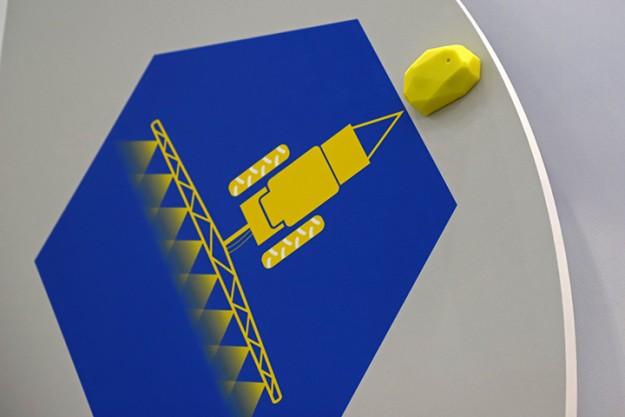
The company has another solution for the equipment: the Asset Tag. That is a bluetooth transmitter that is stuck on the machine. If it detects vibrations when you connect the machine, it will be activated. The GPS screen in the cab then immediately selects the correct implement profile. You only have to enter the data once.
Ready for practice
Trimble will sell the devices in bundles. At the moment the technology is still purchased from a third party, but it hopes to produce it itself and make it smaller. In this way they can be attached almost invisibly to machines. The battery lasts 5 years, but it doesn't say anything about the cost. The aim is to put the technology into practice this year.
The company expects a lot from the new technology, which should also ensure that GPS becomes more accessible to use. In Spence's opinion, users have no problem with all their data being stored digitally: "About 15 years ago we started out 'open minded'. Then this became more and more difficult. I now notice that the opinion of the entrepreneurs is loosening again. In Europe "Do you have privacy legislation that protects the rights of every user. The data we see is always anonymized. Yield and other crop data is especially sensitive. Machine data not so much."
Not interchangeable
Anyone who works exclusively with Trimble will benefit greatly from the new technology; especially with multiple systems or many rental lots. Contractors also benefit. Although it is a pity that lines are not interchangeable between multiple companies. You cannot wirelessly send an AB line to your contractor, or vice versa. It is also not possible to use lines from other brands. Spence expects that this will change in the future, with the arrival of TIM protocols (Tractor Implementation Management).
The company sees this as a step towards autonomous tractors. "We expect to work with master-slave teams in the future," Spence said. "By simplifying the exchange of lines and profiles, the second vehicle can start more easily. Now it still has to be physically present in the field, because it can be done. Dutch farmers are early adaptors. We certainly expect AutoSync and get Asset Tag going with you."

Niels van der Boom
© DCA Market Intelligence. This market information is subject to copyright. It is not permitted to reproduce, distribute, disseminate or make the content available to third parties for compensation, in any form, without the express written permission of DCA Market Intelligence.