Brought to you by Bayer Crop Science
Insect control in Brussels sprouts is a bigger challenge
"It will become even more difficult to grow high-quality Brussels sprouts in the coming years. One hundred percent is no longer enough; you need 200 percent to successfully complete the crop." With these words, Kasper Kleijwegt in Mijnsheerenland (South Holland) expresses his concerns about Brussels sprout cultivation.
Pest control, in particular, will be a huge challenge. "Two years ago, there were seven interventions available against mealy cabbage aphid. Next year—with the discontinuation of Movento and Batavia—that number will be reduced to only two or at most three. And those products are also less effective or much less environmentally friendly."
Are more crop failures on the horizon for Brussels sprouts in the coming years? Kasper Kleijwegt takes a moment to consider that question. "Brussels sprout growers are all consummate professionals. They'll do anything to ensure their expensive crop succeeds. But yes, with the exodus of so many vital resources, I think this will happen in years with high pest pressure." He cites last year's slug damage as an example. "It wasn't actually that extensive, but even a little damage to the sprouts is enough to make them disappear. In that respect, Brussels sprouts are simply a very risky crop."
Worrying times
With the phase-out of the systemic sprays Movento and Batavia (in 2026), Kleijwegt foresees a worrying period ahead. "What will remain are products that actually have to hit the insects. And that's a major challenge for both aphids and thrips—which are often deeper hidden in the plant—and for cabbage whitefly, which lays its eggs on the underside of the leaf." According to him, the latest spraying techniques aren't much help in this regard. "Last year, we tested several spraying techniques on the Brussels sprouts platform. It turned out that the conventional sprayer with nozzles from a lower DRT class actually performed best. That conclusion is quite difficult: for maximum drift reduction, you want to use those new techniques, but with these results against insects, you'll be thinking twice about buying something new."
Flea beetles and mealy cabbage aphids
This spring, flea beetles and mealy cabbage aphids are particularly prevalent. Kleijwegt explains: "Ten years ago, I'd never seen a flea beetle on my farm, but with the disappearance of seed coatings, the problem has become worse almost every year. Besides a specific tray treatment (which can only be done once every three years, ed.), the only remaining sprays are pyrethroids. Besides being environmentally undesirable, this is usually insufficient to prevent or limit damage. Flea beetles are at the base of the crop and therefore difficult to hit; you have to time them very carefully and spray very precisely," he knows from experience.
For Kleijwegt, using pyrethroids feels like "back to square one." "Because of that seed coating, we haven't used pyrethroids for years. But now we have no choice. We know we're not doing nature any favors. But if you do nothing, you'll inevitably damage the sprouts, and buyers simply won't accept that," he reiterates. Regarding the control of mealy cabbage aphids, the situation is just as worrying. He explains: "Two years ago, seven interventions against mealy cabbage aphids were possible within a growing season. Next year, without Spirotetamat, we'll only have one product with a long-lasting effect: Sivanto Prime. Together with two green products and pyrethroids, we have to get through the season. This will be a monumental task, especially with long-lasting crops.
'Risks of Brussels sprout cultivation are increasing'
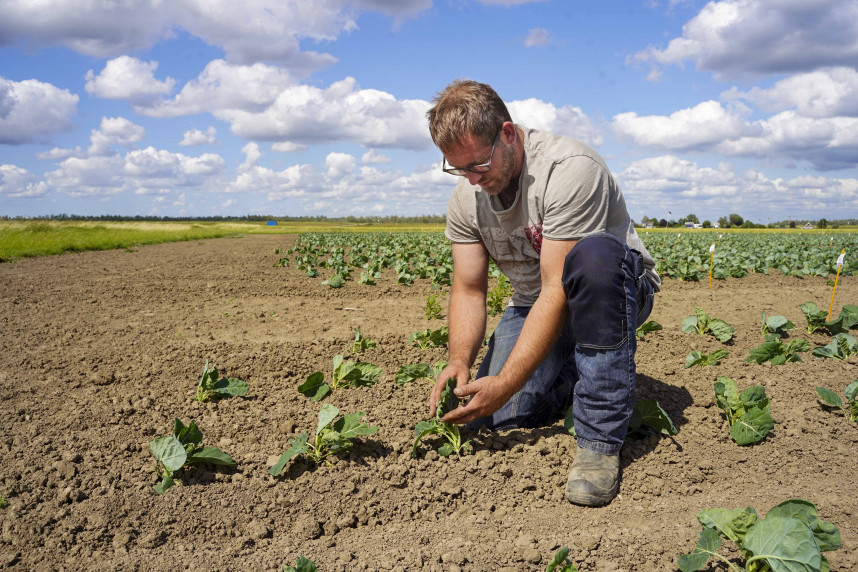
"Look, there's some mealy cabbage aphid here. You can tell by the purplish discoloration of the youngest leaves. And here, on the underside of the leaf, are some cabbage whitefly eggs. They're always neatly arranged in a circle," Kasper Kleijwegt points out during an inspection of the Brussels sprouts platform, which is now in its sixth year at his farm in Mijnsheerenland (South Holland).
The platform focuses heavily on insect control. According to Kleijwegt, this is perfectly logical. "Mealy cabbage aphids, cabbage whiteflies, and even flea beetles are a huge problem in Brussels sprout cultivation. And these problems are only getting worse due to the disappearance of effective, long-lasting products. As a result, the risks of cultivation are increasing year after year. Or, in other words: the confidence that you can successfully complete the crop is constantly diminishing."
Growing without Movento and Batavia
To anticipate a season without Movento and Batavia, Kleijwegt is already omitting both products on one of his own plots and trying to keep the crop "clean" with two biological agents (Neudosan® and NeemAzal® T/S). He can't yet say whether that will be successful. "So far (mid-June), things are going well. But the fact is that insect control on this plot is much more expensive, and the risks are simply much greater. If I had to implement this on all my plots, I expect I'd lose some plots now and then," he says.
With that prospect in mind, a smaller Brussels sprouts acreage is a logical option, Kleijwegt anticipates. "If you know in advance that—despite all your efforts—you won't be able to successfully complete all the plots, you have to ask yourself if you really want such a large acreage. The crop is simply too capital-intensive for that."
'Less fragmented image of the sector'
Despite all the uncertainties surrounding crop protection, Kleijwegt remains determined to keep Brussels sprout cultivation afloat in the Netherlands. This requires not only new (cultivation) knowledge, but also sufficient communication skills to better highlight the sector's challenges, he argues. While the specific cultivation expertise comes primarily from the Brussels sprouts platform, the recently established VGO (Open-Ground Vegetable Organisation) foundation is primarily intended to promote unity within the vegetable sector and become its face to the outside world.
Kleijwegt is enthusiastic about it and says: "With this new partnership of field vegetable growers, we can not only jointly address issues such as plants, soil health, labor, and new techniques much more efficiently and decisively, but we can also project a more powerful, positive, and less fragmented image of the sector."
"I find that last point especially important—a factual and honest picture of our sector—because in recent years, a lot has been said and written about us that's completely off the mark." Although the Brussels sprouts grower strongly expresses his concerns about cultivation, he emphasizes that he still loves the profession. "I enjoy a healthy and well-developed crop every day. And let's be honest: without risks and challenges, there's not much to it anymore," he concludes with a smile.
Neudosan® is a registered trademark of Certis Belchim
NeemAzal® T/S is a registered trademark of Nufarm
