Inside: Onion Market
Competition on the quay affects pool Van Meir
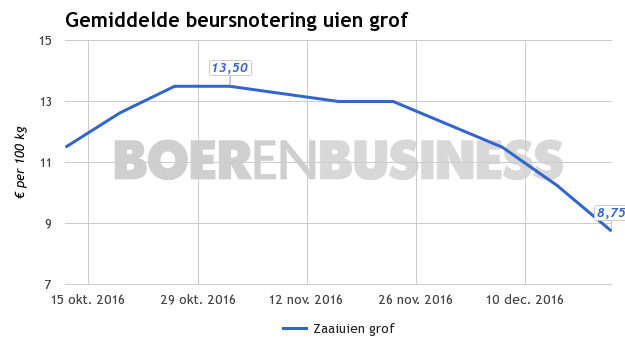
After a top year in the 2015-2016 season, Van Meir's Pool A has to make do with a lower price level for the 2016-2017 season. Nevertheless, the onion packer is satisfied with the result achieved. Competition from Dutch exporters was fierce on West African harbor quays. The result of a one-sided export.
Read this article?
Become a subscriber and get instant access
Choose the subscription that suits you


Pool A ran from week 2016 (mid-October) to week 2017 (second half of December) during the 42-51 season. A total of ten weeks, ultimately resulting in a net result of 12,02 euros per 100 kg. This is a few euros lower than the 17,86 euros per 100 kg of last season, but field service employee and onion specialist Renée Menkveld is satisfied, given the market development during that period.
12,02
euros/100 kg
'We have received questions from some growers because high free market prices were sometimes achieved during those 10 weeks and exports reached a record. In the Netherlands, growers did not always realize how fierce the competition was in West Africa," says Menkveld. 'In the period between mid-October and mid-December, an enormous amount of onions were shipped from the Netherlands to Africa. If we look at the export figures, they tell us that almost half (45 percent) of all exports are aimed at West Africa. And this despite 112 different sales destinations. Many of those onions arrive at the port of Dakar, Senegal, where there is a competition going on.'
Pool A started two weeks later than normal. This has everything to do with the growing season. 'Especially in May, cultivation areas in the east of the Netherlands, but also in Germany and Belgium, were hit by a lot of rainfall,' Menkveld outlines. 'The onion crops took 6 to 7 weeks to recover, causing growth to stand still for almost two months. The result is that the last field onions were only processed very late. Partly because the affected crops did not want to ripen, the harvest time was significantly delayed.'
However, the onion man is very pleased with the color and quality across the board. This is considerably better than last season, and the great asset for the Dutch onion sector. 'The color is great and, in combination with good quality and competitive price levels, this offers opportunities on the global market.' It is precisely this combination that is now sour for growers, Menkveld also realises. The price level does not match the product and the sales achieved. 'Global onion prices are at a relatively low level across the board. The Dutch onion can compete with new short-day onions because it excels in quality. The market is currently small, but if we look at it positively, there are still opportunities. Hopefully the favorable price-quality ratio will convince a country like Brazil. Some destinations, such as the Philippines, Nicaragua and Haiti, are growing in volume. There are also new candidates such as Vietnam, Mongolia and El Salvador, although that is more of a long-term option.'
Van Meir has fixed agreements with growers for the area of second-year onion onions and early seed onions, which means that the area will remain stable in 2017. Menkveld expects that the volume will increase slightly in all pools. 'I have been working at Van Meir for four years now and I see the volume in the pools growing slightly every year. This year is probably no exception. You see both a growth in area, among existing growers, and the growth of new growers. There is not much switching between pool periods. Every grower has a business strategy that suits his products and delivery times. That strategy is often fixed.'
'The growth described in our southern neighbors is mainly in percentage terms. In hectares this is not significant. Belgian growers are used to working with fixed price contracts. There is not really a suitable product for this in the onion trade. They respect that. The growth partly takes place in industrial onions, which are grown under contract. The seasons teach us that distribution in growing areas is important. A weather extreme occurs in at least one area every year. Our working area therefore extends throughout the southern Netherlands. Buying all the onions around our company in Steenbergen entails far too high a risk.'