News Onions
Onion harvest 2023: quality or kilos?
Onion growers have arrived at the final act of the 2023 growing season. The harvest of seed onions is imminent and a start is being made in many places. In many places it is still quite a job to get quality in the box. The advice of onion specialists is therefore not to go for the last kilos but to make use of the beautiful weather.
Read this article?
Become a subscriber and get instant access
Choose the subscription that suits you


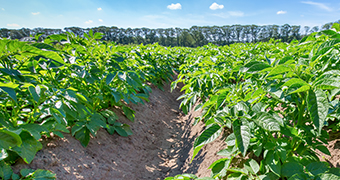
The heterogeneity of onion crops this spring origins during the sowing period also remains relevant during the harvest. You can easily pick out plots that were sown later. Onion crops started growing late, especially on clay soils, which are mainly the traditional cultivation areas. These are also the plots that are sometimes still very green and show no signs of being cleared. Onion specialists call for a critical look at quality. Not every batch is suitable for (long) storage, although growers would like this from a financial perspective.
Lots of fat necks
What is striking, but certainly not surprising, is the large percentage of fat necks or 'bolts' this year. The late-sown onions in particular sometimes struggle with tens of percent loss in a batch. The seed companies unanimously agree that this is a problem and that you certainly do not want these onions in storage. "These onions continue to grow, even in storage," says André Boot of Hazera. "Use a good onion loader with a hedgehog mat and axial rollers to get rid of as many thick necks as possible in the field," adds Kees Jakobs of Syngenta.
"The high percentage clearly has to do with the sowing date," Boot says. "You encounter them less often in irrigated onion plots, or where rain fell on time. When it finally started to rain, mineralization started and that is also a factor in the formation of thick necks."
Fusarium
Other quality issues also occur more often than what the grower would like. Pinkroot is an issue, but it doesn't bother you in storage. With fusarium it is a completely different story. Boot: "Where there has been a lot of driving rain or where there has been irrigation with many millimeters, fusarium regularly occurs. This is also current. The temperature is rising and an onion that is in the ground can become infected. In six weeks you will find it in the storage. For that reason alone it is advisable to dig up now."
Arable farmers are already gradually harvesting seed onions, especially in the southern part of the Netherlands. Things will probably really get going during this week. Even if the crop does not settle properly, it is still advisable to use the harvester, the specialists think. Giving the onions a helping hand with ironing can certainly have a positive effect, although it is small in early September. "If there is a lot of rain, the shaft can become full of rain, resulting in bacterial disease, says Bart Schriever of De Groot & Slot. You also have to dry more in storage, but it is still advisable to harvest on time."
Longer field period
Boot advises growers to raise the height of onions that are still standing. "Preferably above the split of the leaf. There is now a lot of moisture in the neck and the longer foliage helps in storage as a tissue paper to dry the neck." Early September is the ideal time for the onion harvest. If you get a wet period, it will be October before you can start. At the current temperatures, the onions can also dry for a few days in the swath. This can have a positive effect, especially when harvesting is done in a fairly green way. Whether there is a risk of sunburn depends on the UV index. It is lower at the beginning of September and the days are also shorter than in July or August.
Schriever: "MH spraying has been successful in many places. Only crops that have suffered from disease - which has affected the foliage - can show reduced uptake. If that is a point of doubt, you can assume that the MH admission has not been ideal."
Large yield spread
Because there are such differences between growing regions and even within regions, it is difficult to give a clear answer about yields. On average, you will find the most beautiful plots in eastern Netherlands on sandy soils, although there are also beautiful onions in the south of Limburg. Onions on sandy soil in the northeast and southeast are sown on average on time and have developed sufficient foliage. "Nationally we expect 40 to 45 gross tons per hectare," says Schriever. "The spread is very large. All crops are later this season and that also applies to the onions. Enough crops are still very green and not harvesting. When are you going to dig them up? That is the challenge."
Jakobs expects the onion yield to be lower than last year. "It is difficult to say exactly. There are plots of 60 or 70 tons, but also of 50 or less with a lot of tare. The final sowing date has been extended again this year to May 10 or even later. On those plots you hardly see a bulb. "Sowing late has simply not worked out well on clay."
Boot also sees this spread among growers. "You come to companies that make a balance of minus €9.000 per hectare, but also companies with a plus of €40.000. Particularly in Zeeland, you still see plots with a yield of 10 to 15 tons that are no longer harvested at all. Traditional growing areas have really affected the bean and onion fly this year. You don't see that in the new areas, because the pressure is much lower there."
Ideal harvesting conditions
After heavy local rainfall at the end of August, the soil is now very soft. As soon as conditions permit, Luc Remijn from Delphy also advises to start harvesting. "There are a lot of roots under the onions and in dry weather it is more difficult to dig them up. Moreover, the risk of damage increases. Even though the onions are difficult to iron in many places, harvesting is the best option. Give a helping hand with ironing In our experience, it has no effect on seed onions. It is purely visual." Remijn also advises growers to clap longer when the foliage is still standing. "In the shed it is a matter of drying a lot and not looking at the storage losses. This is different with potatoes, where the line between quality and quantity is thinner, but with onions the quality really comes first. Especially when you work with, for example, fusarium infestation."
Despite a recent price drop, the farm prices are currently historically high. Yet many growers are not very eager to do business, hoping that a (much) higher price will be achievable during the storage season. To achieve this, there must be quality behind the planks. Moreover, the same quality is also required to keep the Dutch export engine running. This requires the right choices now when harvesting.