Background Half-year figures
Rabobank's sustainability fund starts running
Agricultural entrepreneurs are finally starting to access Rabobank's €3 billion fund for sustainable agriculture. Of the amount set aside in June 2023, only €2024 million had been allocated by December 500. Currently, that amount is €900 million, says Rabobank CFO Bas Brouwers.
Would you like to continue reading this article?
Become a subscriber and get instant access
Choose the subscription that suits youThe vast majority of those applying for a loan from the sustainability fund are doing so to purchase additional land. "It's good that steps are being taken in the area of extensification and that more land is being purchased, which will allow companies to comply with regulations more quickly." Funding is also being requested to transition to other business models. "We're pleased that this is being taken up. Companies can still apply until 2030, so they still have plenty of time. It's a success for us that it's being used and that entrepreneurs can offer this," said Brouwers during the presentation of the half-year figures.
The CFO attributes the fact that agricultural businesses are now able to access the loans to the fund's wider recognition among agricultural entrepreneurs. It's certainly not a political issue. When the fund was created, the parties were forming a new government, and now the cabinet has resigned, with new elections looming. "That volatility isn't helping us gain clarity," says Stefaan Decraene, Group CEO of Rabobank. In December 2023, Rabobank presented its own agri-food vision for 2040 in anticipation of political developments.
Investments in agriculture limited
Total outstanding domestic food and agri credit rose slightly in the first half of the year compared to the end of 2024, from €46,1 billion to €47,6 billion. It is also reported that outstanding agricultural loans remain stable and that "investment is limited." "Agriculture is flat in the loan book; we know the reasons. It is good that there is stabilization," says Brouwers. Traders benefited from lower interest rates and inflation in the past six months, while last year raw materials and animal proteins were under pressure, there was oversupply, particularly in fruit, and weather conditions were uncooperative everywhere.
Rabobank has no insight into the impact on entrepreneurs using termination schemes. Brouwers, however, doesn't expect the Dutch agricultural sector to be significantly affected. "The question is whether that will have a significant negative impact immediately. There are alternatives abroad. The world population is growing, and so is the global demand for dairy products, for example."
When asked, the board members indicated that they currently have "no concrete indications" that point to a deterioration in the financial situation of arable farmers, who, after several good years, are facing low prices this year, such as for potatoes. Decraene adds that this, however, "offers no guarantee for the future." "Agriculture finances not only with borrowed funds, but also with equity. Product prices are volatile, fluctuating, and logically, they have the resilience to cope with that."
Limited effect of US import tariffs
The outstanding foreign loans in the Food & Agri portfolio will decrease in euros from €73,7 billion as of December 31, 2024, to €69,6 billion as of June 30, but the bank attributes this to exchange rate effects caused by the strong euro. Overall, they will remain stable there as well. In Australia, however, there is an increase. According to the board members, Trump's high import tariffs will have a limited effect on the global food and agri portfolio. "America has a 10% stake in global trade, but not 90%. These trade flows will also spread, and these often involve products that are basic necessities; the tariffs will have somewhat less impact on those."
The EU-US agreement has reduced uncertainty somewhat, the board members indicate. The bank's forecasts have revised economic growth downwards by a few basis points. Growth rates for 2026 and 2027 are below historical averages due to "protectionism and eroded global trade," but the bank remains positive about the economy's resilience. However, it is cautious. Brouwers: "With all the trouble spots in the world, if there's an escalation, the scenarios can be scrapped.
The bank's own contingency fund is historically low, as is the case at other financial institutions. €2,5 billion has been reserved, compared to €5 billion during the coronavirus pandemic. This includes €80 million for geopolitical unrest and €100 million for climate impacts.
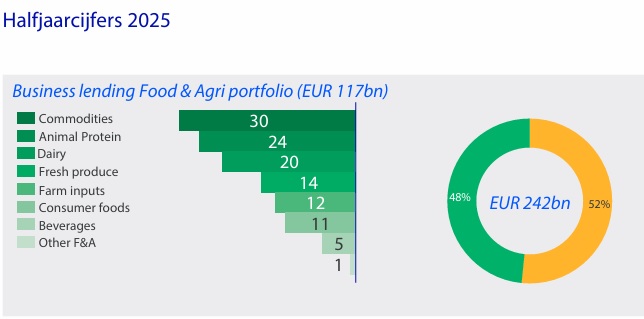
Overall, revenues declined due to lower interest rates, but in Wholesale & Rural, profits increased (+29%) due to higher outstanding loans in 24 countries worldwide. There was growth in activities across the board, including supply chain financing, and according to the board, the bank was also able to help more clients hedge their commodity positions.
Strong and healthy result
The bank noted that geopolitical unrest is causing larger companies to hold their breath, but the situation "normalized somewhat" in the second quarter of this year. This cautious approach was offset by further growth in the Netherlands, including in corporate loans. Rabobank's net profit was slightly lower in the first half of the year, at €2.694 million, compared to the same period in 2024 (€2.818 million), but the board members are satisfied: "We consider it a solid and healthy result." They emphasize that it's important to remember that a record profit for a first half was achieved last year.