Dutch Crop tour Ruud & Lotte Steinbusch
'Innovation and diversity are essential'
In the arable farm of Ruud Steinbusch and his daughter Lotte, innovation and diversity are central. The participants in the Boerenbusiness Crop tours strive for an approach in which they are not tied to calendar agriculture, but rather respond flexibly to natural processes. They have recently also started growing sunflowers, and according to Lotte, a lot of steps are being taken to ensure that the sunflower seed ends up on the bread at the bakery."
The 2024 growing season will also follow Boerenbusiness Dutch Crop tour another ten plots with Innovator chip potatoes. From planting to harvest, the participating arable farmers take us through the cultivation and decisions they make during the season. In this series of interviews we each get to know one grower, his company, vision and strategy. The Limburgers Ruud and Lotte Steinbusch are now well-known participants in the Crop Tour.
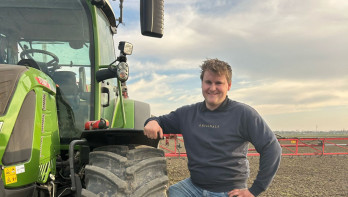
Ruud Steinbusch has an arable farm in Voerendaal in South Limburg. His daughter Lotte supports him in this. The company encompasses a variety of activities including; arable farming, contract work, earthmoving and cultural engineering works. On their total area of 120 hectares, they not only grow conventional crops - such as grains, beets and potatoes - but have recently also started growing sunflowers, field beans and chickpeas.
Diversity in crops
"The most important crops within our company are beets and potatoes. The grains serve as a rest crop. The field beans are for Albert Heijn and the sunflowers are our own project that we have set up with our partners in a project group," laughs Ruud. "We have never seen the cultivation of sunflowers in our area before." "We also work with a local baker who will use the seeds on his bread," Lotte continues. "The cultivation of the sunflowers themselves is not the biggest challenge, but after the sunflowers have been harvested, a lot of steps have to be taken to ensure that the sunflower seeds end up on the bread at the bakery."
The diversity in the company goes beyond just the crops. Steinbusch also carries out contract work for arable farmers, fruit growers and livestock farmers in South Limburg. "We assist fruit growers in creating plots and carry out activities such as manure injection and vibrating poles. We see more and more grape growers within our area. This provides a nice variety in our work during the season. In April we are working on sowing beets and planting potatoes, followed by planting grapes in May. This variation fits very well with our vision of diversity and innovation in agriculture."
Breed Innovator
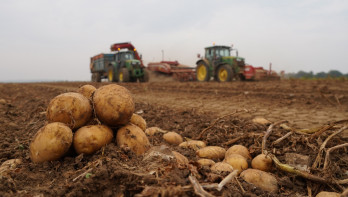
The potato plot that Boerenbusiness during the Crop Tour, there is one of 9,5 hectares Innovator. A plot located on the farm. This is approximately a quarter of the 40 hectares of French fries potatoes that Ruud and his daughter grow. Lotte: "We used to grow Fontane, but because of the earlier ripening of Innovator we switched to this variety. Now there is a little more spread in the harvest season and we are not forced to dig everything up in October. We can start harvesting in mid-September. harvesting from Innovator. This gives one or two weeks of space during the harvest. We grow one in four and try to have a pre-crop as grains. This is not always possible all crops on loess soil, where it is important that we leave green manures in order to prevent erosion."
"We store the potatoes ourselves in our warehouse," continues the arable farmer. "Instead of a special storage area, we use straw against the pressure wall as insulation. We store the potatoes in this warehouse until the end of January or the beginning of February." Lotte and her father indicate that they no longer want to store the potatoes. "All spring work will then slowly start again, including spreading fertilizer and injecting manure. We would like to be done with the potatoes by then. It is a storage facility in which grains are also stored. We grow a third under contract, a third in a pool and one-third free."
Lotte and her father have had an irrigation reel for a number of years. "We use this in the potatoes and onions. If necessary, it comes outside, but we only irrigate during the tuberization of the potatoes or before the onions emerge. The groundwater here is at a depth of 160 meters, so we irrigate with tap water.”
Crop protection and irrigation
Lotte and her father recently switched to a field sprayer equipped with a Wingssprayer, which they now pay extra attention to to improve drift reduction. In addition, they have switched from a self-propelled sprayer to a trailed sprayer. They use Agrifirm's BOS system to combat phytophthora. They also use camera-controlled hoeing. In beets they aim to use more mechanical methods instead of crop protection.
"The preliminary crop of the chip potatoes on the Gewastour plot is wheat. After the wheat, fertilizer is added. After this, we sow yellow mustard. In the spring, basic fertilizer is added on top. We never plow near the potatoes. The only time we Packing the plow is after the harvest of grain and beets. That is also only a thing of recent years, we are in a hilly area here."
Vision and challenges
Lotte says that she works as an HR consultant most of the week. She also works from home in the company. "This keeps the week nice and diverse. It is a challenge to get the best yield from our crops every year. We also like a bit of risk. For us, it does not always have to follow a standard procedure."
The vision of father and daughter is not to be too dependent on calendar farming. By this they mean that they do not adhere to strict dates for, for example, harvesting the potatoes or cultivating the land. “I am convinced that the biggest challenge lies in the educational aspect, namely making consumers understand that agriculture is a natural process,” says Ruud. "As a grower you cannot always work according to a fixed schedule. It is a challenge for the agricultural sector to involve consumers more in the natural process of food production and make them aware of the product they grow for them."
© DCA Market Intelligence. This market information is subject to copyright. It is not permitted to reproduce, distribute, disseminate or make the content available to third parties for compensation, in any form, without the express written permission of DCA Market Intelligence.