Dutch Crop tour Potatoes - week 40
Potential top innovator runs aground on regrowth
The trial harvest figures of the Innovator variety on the plots of the Boerenbusiness Crop yields have been quite disappointing in the final stages of the growing season. After a strong start, which was also reflected in the interim trial harvests, the average yield ultimately fell below the long-term average.
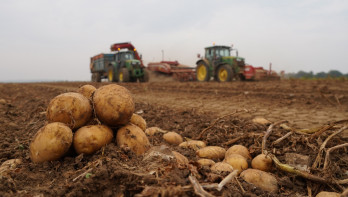
After a nationwide dry growing season, the potato harvest is in full swing. In the south, it's still so dry that it's difficult to get the potatoes neatly into the sheds without damage. Above the major rivers, however, there has been ample rain. The further north you go, the happier they are with every dry day. Growers in the south describe it as an unprecedented situation that it's still so dry around October 1st. According to the weather forecast, precipitation will fall starting this weekend, but growers don't really want to wait for that. The further back in time you go, the more difficult it usually is for the soil to dry out again. As a result, several irrigation reels will still be visible in the south this week, where possible.
Trial harvests on Gewastour plots
In recent weeks, trial harvests of the Innovator variety were carried out on ten Gewastour plots across the Netherlands. Three meters of potato ridge were harvested at various locations on each plot to obtain a general idea of the yield. This was done just before harvest, when the crop had reached full maturity.
| Location | Final net proceeds in tons per hectare |
Net gain weekend 31 in tons per hectare |
Percent weight in 50mm up | Number of times watered | Soil type | paw dates |
| Appelscha | 42,4 | 19,5 | 82 % | 0 | Zand | 14-May |
| (Friesland) | ||||||
| Dronten | 65,8 | 53,3 | 74 % | 2 | Clay | 24 Mar. |
| (Flevoland) | ||||||
| Elst | 52,5 | 49,2 | 88 % | 3 | river clay | 2 Apr |
| (Gelderland) | ||||||
| leuth | 58,5 | 46,2 | 91 % | 5 | river clay | 8 Apr |
| (Gelderland) | ||||||
| Kite | 51,7 | 43,4 | 89 % | 4 | Zand | 21 Apr |
| (North Brabant) | ||||||
| Hellevoetsluis | 53,8 | 43,1 | 92 % | 1 | Clay | 14 Apr |
| (South-Holland) | ||||||
| Uithuizermeeden | 57,9 | 46,2 | 95 % | 0 | Clay | 14 Apr |
| (Groningen) | ||||||
| IJzendijke | 27,1 | 23,4 | 85 % | 0 | Clay | 10 Apr |
| (Zealand) | ||||||
| Voerendaal | 50,5 | 40,5 | 93 % | 2 | loess | 14 Apr |
| (Limburg) | ||||||
| Midwolda | 60,2 | 44,2 | 92 % | 0 | Clay | 10 Apr |
| (Groningen) | ||||||
| Intermediate | 52 | 40,9 | 88 % | 12 Apr |
*Yield in tons/kilograms per hectare. 15% of the yield has been deducted for spray marks, tare weight, headlands, etc.
The average yield is 52 tons per hectare, with a limited variation. For example, six of the ten Gewastour plots were between 50 and 60 tons. The difference between the outliers at the top and bottom was considerable, ranging from 27,1 tons to 65,8 tons per hectare. The plots in Dronten (65,8 tons) and Midwolda (60,2 tons) both exceeded 60 tons.
Since the interim trial harvest in week 31, an average of 11,1 tons has been regrown. This means regrowth has been significantly lower than in previous years. On the Gewastour plot in Elst (Gelderland), the trial harvests showed a regrowth of only 3,3 tons.
With an average yield of 52 tons, the 2025 growing season is below the long-term average of 55,2 tons per hectare. Compared to 2024, the yield is almost 5 tons lower, while for many growers, the wet weather made last season one to quickly forget. Compared to 2023, which was also very wet, the yield is only 2 tons higher.
This is largely due to the fact that only 11 tons (27,1%) of crop growth has been achieved since the interim trial harvest. Based on the long-term average, the average growth since the interim trial harvest is still over 47%. Based on these data, regrowth this year has been very poor.
Growing days and drought determine regrowth
The fact that regrowth was less than ideal this year requires some context. At the time of the interim trial harvest, the Gewastour plots were already averaging 109 growing days. This means that the Innovators had already set a considerable number of kilos due to the early spring, which saw the planters enter the fields incredibly early this year. The dry August dealt the Innovators a final blow in terms of regrowth. Many growers left their irrigation reels in the shed in August due to the potato price, which was considerably lower during the growing season.

Location more decisive than planting date this year
Although the average yield variation is relatively small this year, participants in the south had to put in more effort to achieve this yield than those in the north. This is clearly reflected in the number of times the Gewastour plot was irrigated. In the south of the Netherlands, irrigation was received between one and five times this growing season, while participants in the north had to make do with zero to two. Although all three plots were planted in the same week, the plot in IJzendijke (Zeeland) could not be irrigated. This plot yielded 27,1 tons per hectare, while the plots in Uithuizermeeden and Midwolda (Groningen) were also not irrigated, yielding 57,9 and 60,2 tons per hectare, respectively.
Although the plot in Appelscha (Friesland) was also not irrigated, it was planted a month later on average. The reasoning behind this was: "If you plant early, you'll have a relatively 'older' crop as the summer progresses. If you plant later, the 'younger' crop can withstand droughts a bit longer in the summer." This was also clearly visible during the interim trial harvest, where the Appelscha plot lagged considerably behind. Despite the dry August, the yield on this plot has more than doubled since the first trial harvest. Nevertheless, René Mesken decided not to irrigate the plot due to the potato market situation, which meant the Innovators couldn't achieve their full yield potential. "Two irrigations in August would have resulted in a significantly higher yield," he concludes.
Hindsight is easy, of course, but the 2025 growing season certainly had all the makings of a potential winner. Early planting offers the opportunity for more growing days. To be fair, with the growing season we had, provided irrigation was available (and indeed it was), there was plenty of potential to optimally utilize the extra growing days this season.

Jan Willem Veldman
© DCA Market Intelligence. This market information is subject to copyright. It is not permitted to reproduce, distribute, disseminate or make the content available to third parties for compensation, in any form, without the express written permission of DCA Market Intelligence.