9 questions for Minne Lettinga
Price ground rent The Netherlands is owned in Romania
About 8 percent of the agricultural land in Romania is owned by foreigners. The Netherlands is one of the largest investors there. Frisian Investors has been investing in land since 2008 and sees great opportunities. 'It takes a farmer in the Netherlands about thirty years before he has repaid the loan on purchased land. In Romania you are ready after a few years', says partner Minne Lettinga.
After eight years of pioneering in Romania, the Frizon Group has expanded considerably. With its own office space, two agricultural companies totaling 3.700 hectares, a brokerage and subsidy office and of course the Frisian Investors fund that started it all.
How are business?
'The fund with capital round number 4 is now full; this means that it is no longer possible to invest in this capital round of almost 2,5 million euros. There will be a next round this year, probably worth 1 million euros. There are 2.150 hectares in the fund that will be leased to Romanian farmers and a few affiliated Dutch companies. I expect a lot from our activities. Until recently, it was not common in Romania to obtain a mortgage as a foreign party. At that time, the Land Registry usually did not have its affairs in order and the banks did not dare to do it either. But now we can also get our own mortgages with our companies and that at reasonable interest rates.'
However, the Romanian government is not always positive about the purchase of land by foreigners. What do you notice about that?
'It is currently being made a little more difficult for foreigners to buy land. In the short term, this could lead to a standstill in prices. If the government imposes difficulties or restrictions on foreigners, there will be less supply of foreign money. Farmers themselves ultimately determine the value of the land and foreigners bring money. That money is spent in Romania, which gives a crank to development. A higher yield, more turnover, more transport, etc. If you think nationally, that could work against Romania.'
Rabobank was discredited at the end of 2015 because of stolen agricultural land. Isn't that a risk?
'After the fall of dictator Ceausescu in 1989, land was returned to the families that gave them the right to property. Those families should have gone to the notary to legalize it, but because of the cost, the majority have not. It is not always possible to trace the previous history without an entry in the land registry. At the time of purchase, the lot still has to be legalized by the original owners. Then you sometimes have to deal with heirs who have to be traced, powers of attorney arranged, to the notary to get the title, then to the land registry… Very complex and sometimes it takes years.'
'It is not very strange if there are a number of transactions that may not have been concluded in good conscience by the previous purchasers. If a journalist finds out, the latter party will be cast in a bad light, while it has happened to the previous purchasers in the process before. rabofarm owns about 35.000 hectares of land in Romania, with such large quantities that opportunity may exist.'
How do you avoid such problems?
'In order to prevent suspicions such as at Rabofarm, we try to work legally and neatly. To this end, we set up our own agency in 2011 that takes care of the purchase and registration of titles for us. We now also have our own real estate agency and we mediate with local managers for Dutch people who want to purchase land in Romania. In addition, we run our own subsidy office to make use of the enormous possibilities for subsidies from Europe. Everything must be neat and well documented. I estimate that Romania is not even using 30 to 40 percent of the possibilities.'
In 2015, the price of land rose by about 10 percent and it continued to grow in 2016. What is the current level and which way is it going?
'Land prices on the Hungarian side are higher than on the Moldovan side, where registration by the land registry has traditionally been less in order. The fact remains that huge jumps can be made in this country with land prices from 4.000 to 6.000 euros. In Groningen, a hectare costs 60.000 euros and you achieve a yield of 10 tons of wheat. That yields 2.700 euros per hectare. It takes you as a farmer 30 years of work to repay your loan.'
'In Romania you pay 5.000 euros for a hectare, you harvest 5 tons and have earned back the investment in a few years. Especially because we are growing in yield. We started with 3 tons per hectare, we are now at 7 tons and when the irrigation systems work you will move towards 12 to 15 tons of grain maize.
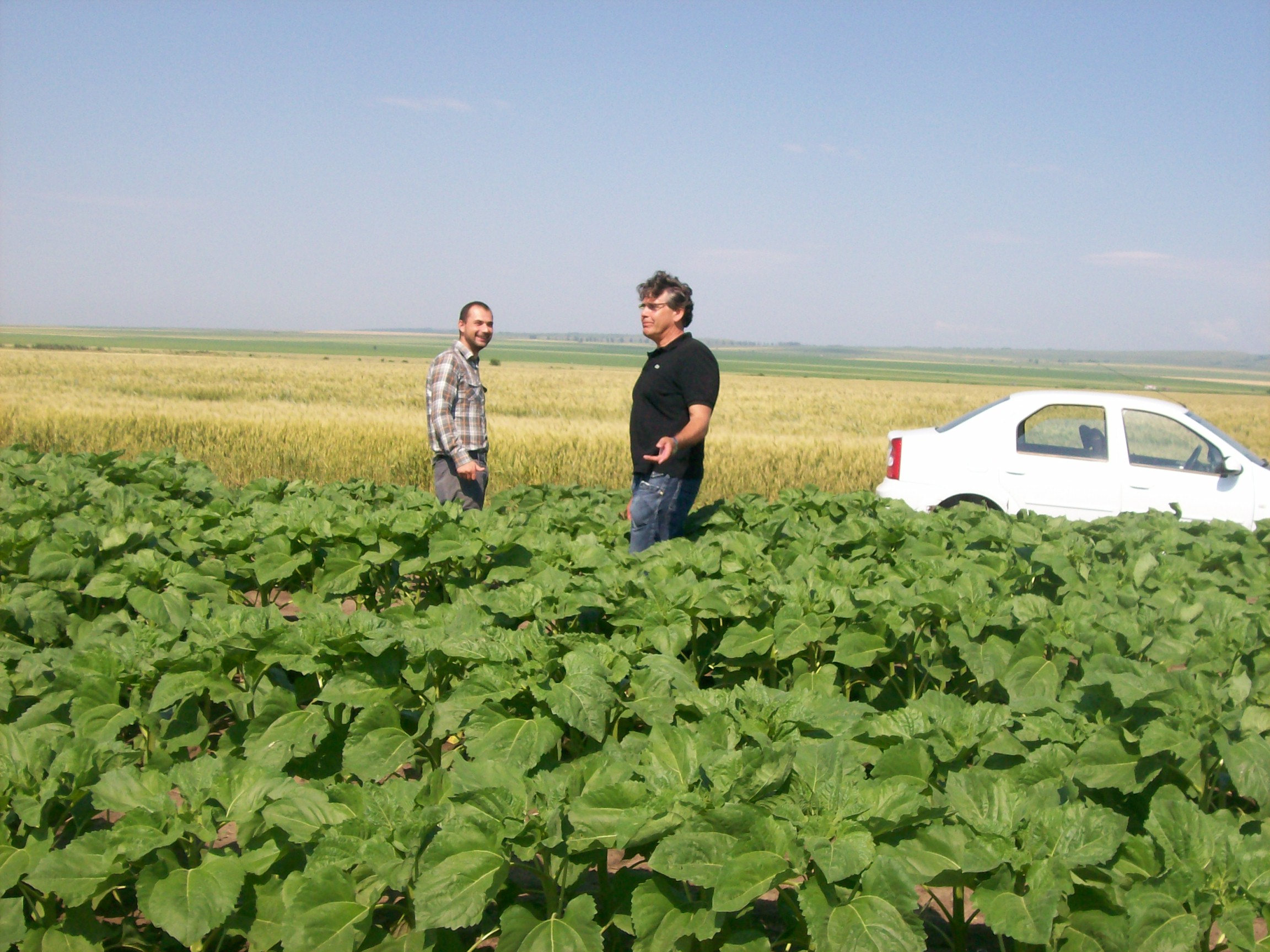
With the continental climate here, maize, sunflowers, soya and peas give good yields. The soil where we farm, near Bordeaux (Fr.) is of very good quality. If you could irrigate here, the land price could go towards 15.000 to 18.000 euros. Still easy to finance and pay. According to the major institutes in Romania, soil that is more difficult to irrigate will ultimately yield between 10.000 and 12.000 euros. In the next five years, the land prices are expected to double, but it depends on the raw material prices.'
What can Romanian agriculture take a spurt with?
'In Ceausescu's time the irrigation was done, but after the fall of communism everything fell into disrepair and was looted. It is now possible to carry out repair work with high subsidies and a substantial contribution can be received for the construction of a pivot. With such a controlled irrigation system, the grain maize yields reach 15 tons. With prices of 150 or 160 euros per ton, you have a fantastic operating result. The only point is that you must first have the money to start. That is a big problem in Romania.'
How can that initial investment be collected?
'In Romania you start with your own money or from an investor. If you can prove that you are a good entrepreneur, you go to the bank. Another solution is supplier credits; big boys like Cargill sometimes want to finance foreigners at 10 to 12 percent. As a company, we have now reached the point where we can go to the bank. And the great thing is that there are 20 to 25 banks in Romania. This leads to mutual competition, because the banks want to bring in companies with good results. The Italian, Austrian, Greek, Scottish and Dutch ING; they all want to generate market share. In the Netherlands you are ready quickly, but here we can shop.'
Is the situation in Romania comparable to that of, say, Poland 15 years ago?
'Definitely. Poland has come a long way since then. They have obtained a large market share in the fruit sector, there is strong growth in potato cultivation, the poultry sector has undergone a boost and slaughter and processing companies will also see the light of day in the foreseeable future. That will also happen in Romania, I predict. In addition, the quality will increase, while the cost price will remain low in the coming years.'
How important will Romania become in agriculture? What else can we expect?
'It will be a huge agricultural nation with good opportunities for young people. On the scale on which farming takes place in Romania, you can make optimum use of smart farming techniques and spread out the investment. There is no manure problem here; there is a shortage of phosphate. Everyone is in the mood. Brand new farm equipment is going like hotcakes. You can feel in everything that the country is on the eve of a new era. The Romanian currency is very stable, the parking lots of the hardware stores are always full because everyone is refurbishing, the roads are getting busier, the streets are being asphalted and here is the fastest fiber optic network.'
'In addition, Romania only started to borrow money on a global scale in 1990; as a result, they have the lowest government debt of all EU countries. Also, all national reserves are still there, because the communists did nothing with the natural gas, metals and oil present. The younger generation, in particular, wants to move forward. That's very inspiring. In the Netherlands, the prices are so high that it is almost impossible to achieve a return. A Romanian bank co-finances up to 70 percent at 3,5 percent interest. What you rent for in the Netherlands, you own land here. A nice business model.'
© DCA Market Intelligence. This market information is subject to copyright. It is not permitted to reproduce, distribute, disseminate or make the content available to third parties for compensation, in any form, without the express written permission of DCA Market Intelligence.