Analysis Feed market 2018
From high straw price to record price meadow hay
For dairy farmers, 2018 was mainly dominated by phosphate rights. This has also had an impact on the feed market, for example because there are fewer mouths to feed. Which 3 price movements stood out the most in 2018? An overview.
Would you like to continue reading this article?
Become a subscriber and get instant access
Choose the subscription that suits youIt was not only the fact that there were fewer beaks to feed that was reflected on the feed market. It was also widely known that dairy farmers had to save quite a bit of money for the purchase of phosphate rights; at peak time the price was as high as €274,50 per right (DCA listing of phosphate rights).
1. Turbulent year for straw
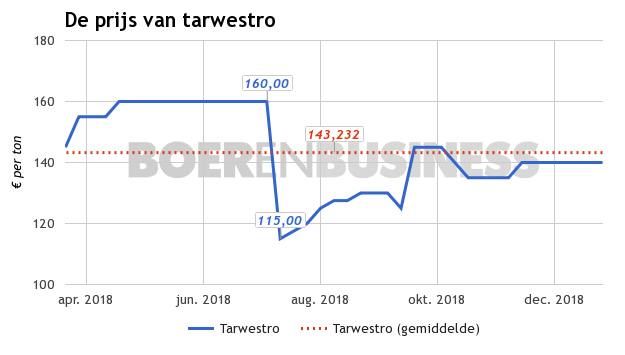
At the end of 2017, the straw trade was already experiencing serious shortages and this was exacerbated by the transport problems surrounding the holidays. It resulted in the product entering the new year with the highest price in years: €130 per tonne free of charge (both barley and wheat straw). While the prices of other roughage products were under pressure at the beginning of 2018, the price of straw managed to rise one after another.
This caused the price the end of March managed to break the barrier of €150 per tonne (free of charge). During this period, little product could be obtained from France, which led to a switch to product from Spain. This entailed a greater transportation distance, which resulted in traders being forced to raise prices. As a result, the top of the price range even rose to €175 per tonne, although the average price did not exceed €160 per tonne to rise.
However, at the end of May the fireworks at the straw market were over. Demand decreased rapidly and therefore the price remained stable until the new harvest. The first expectations for that new harvest arrived beginning of June at €110 to €120 per tonne (free farm) and from mid-July these prices were actually traded. However, the price did not remain at that level for long, because at the beginning of August it had already risen to €127,50 per tonne.
Due to the drought, many French and German suppliers held on to their product, resulting in a tighter supply once again. This caused the price to rise mid-September to €145 per tonne free at farm. The big question was: will this price increase continue? Although it was expected that prices could rise further, this did not happen. Since then, the price has fallen slightly and the market closed the year at €140 per tonne, free of charge. This means that 2019 will start with a higher price than in 2018.
2. Meadow hay rises to record levels
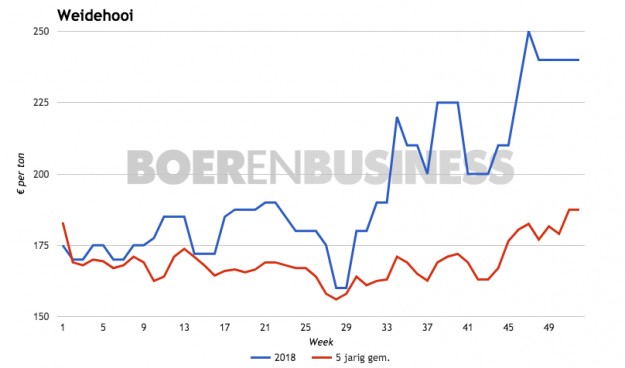
The meadow hay market was in a difficult situation at the beginning of 2018 the year started therefore with a paltry €170 per tonne, free of charge. Then trade continued and there was little demand; between week 2 and week 26 the price barely exceeded €185 per tonne. The highest quotation was €190 per tonne in the first half of the year.
At the beginning of July they switched to the new harvest and the quality turned out to be surprisingly good. As a result, the relatively high starting price of €160 per tonne was seen as more than justified. Due to the high demand for the product, the price reached €2 per tonne (free of charge) in less than 180 weeks. And with that move, the rise seemed unstoppable.
In the weeks that followed, the product became apparent scarcer than previously thought, causing the price to rise to record highs; By mid-September the price stood at €225 per tonne, free of charge. The drought, which played a major role in every company at the time, began to have an increasing effect. Panic about a possible roughage shortage caused dairy farmers (and horse farmers) to purchase more product.
This was the reason for many traders to significantly increase prices, causing the price to peak at €47 per tonne (free of charge) in week 250. That was the highest level since the 2011/2012 season. Ultimately, the market fell again, mainly because there was less demand, and closed the year at €240 per tonne. This starts 2019 at the highest level in years.
3. Drought pushes up corn silage prices
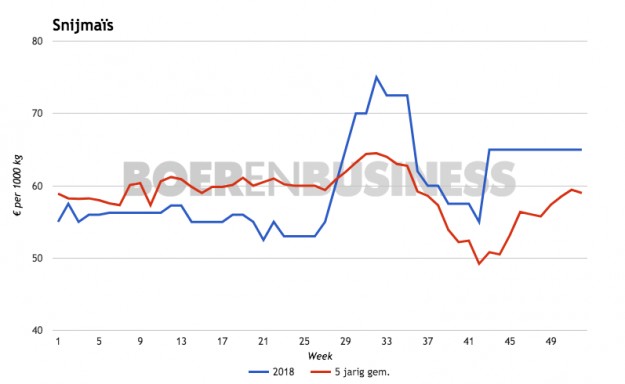
It was striking that the trade in silage maize was not going well at the beginning of 2018. There was little demand and the price was at a relatively low level (€55 per tonne); the market was even down at this time of year below level of previous years. This was partly due to the low price of corn gluten, which dairy farmers preferred at the time.
Here too the new harvest life in the brewery. Drought affected the quality of the new harvest very variable, which made the really good quality very popular. It resulted in record high prices. In 2 weeks, the price rose from €53 per tonne free of charge to €70 per tonne free of charge, a record (week 32).
However, the price did not maintain this level for long, which also had to do with the quality. The good quality was sold out, so the price had no choice but to drop; in week 42 this amounted to €55 per tonne, free of charge. Because some silage maize could be collected from the field later in the year, the price was still lower step up to do. As a result, the product closed 2018 with a price of €65 per tonne, free of charge.
What will 2019 bring?
When we look at 2018 as a whole, we can at least conclude that it was a year with many price increases. In addition to the aforementioned increases, spent grain rose from €2 per percent dry matter to €2,70 per percent dry matter and perennial ryegrass recorded a gradual increase from €120 to €160 per tonne.
Whether prices will set records again in 2019 is anyone's guess. The various forage traders report that the winter is decisive will be. If we have an early spring, then there may be nothing to worry about. However, when spring is late, there can sometimes be a roughage shortage. In short: patience is a virtue.
Want to stay informed about feed prices and changes this year? Then check it out our database and compare prices with previous years.