Interview Jan Anchor
Growing A-ware keeps the door open, also across borders
The books on the year 2023 are not yet closed, so Jan Anker (CEO Royal A-ware) cannot yet give a real assessment. He doesn't let himself be tempted into it either. He does give a few first impressions in an interview. In the meantime, A-ware keeps the door open for suppliers, including across the border with Germany.
Read this article?
Become a subscriber and get instant access
Choose the subscription that suits you


As far as he is concerned, they are that it has been a challenging year, with a lot of volatility. But also with a cautious increase in purchasing power of consumers, which caused dairy sales to pick up in the second half of this year. A-ware had to keep a close eye on costs, which puts the company in the same boat as dairy farmers.
Can you explain that a bit?
Anker responds thoughtfully. Reviewing the various areas of interest, he strongly identifies with the position of his suppliers: "We have also done our utmost for them to achieve a good milk price again. We are well aware of the increased costs on the farm. That is why the extra premium to the December milk price."
The fight for the milk also plays a role, right?
Anker smiles: "We are a dynamic company that wants to continue to respond to the demands of our customers. We continue to build according to our strategy and that also requires milk. Now and in the future."
Companies are taking a position with a view to an expected contraction in milk production in the Netherlands and possibly also more widely...
"That could be possible. There is a lot of uncertainty surrounding policy and regulations and that puts pressure on dairy farming and our sector. We are following our own course."
Perhaps with a new coalition and perhaps also with changing insights in Brussels, see the increased attention to food security, less emphasis will be placed on all kinds of restrictive matters than first feared?
"Let's hope that a little more sense of reality returns to politics. Ultimately, there are only a few places in the world where dairy can be produced well. Northwestern Europe is one of them. The dairy farmers there are ideally positioned. And with their knowledge and craftsmanship, is produced in a very sustainable way. Let's be careful with that. Milk production is becoming increasingly important."
What is your view on price developments in dairy?
"There is a lot of volatility in the market. There is economic uncertainty and political unrest in several places in the world. For the longer term, the prospects are positive and dairy prices will rise."
How do you respond to market developments?
"In the Netherlands we have six milk flows. In Belgium we also have several and we are working on developing even more milk flows. All links in the chain must always have lasting benefits: dairy farmers can continue to farm and customers continue to choose us. We are continuously working to broaden our commercial base and invest in the further development of our milk flows."
You also added many dairy farmers last year. Can you handle all the milk supply?
"Our COO Klaas de Jong and his teams are always able to have more milk processed in our factories every year. We are also flexible and can accommodate this very well."
What is your processing capacity and number of suppliers now?
"We now process more than 2 billion kilos of milk and there are more than 1.500 dairy farmers who supply us."
The impression sometimes arises that A-ware does not have to make much effort to attract farmers, while other parties have difficulty retaining farmers. Do you have an explanation for this?
"I can't say anything about other companies. Just like dairy farmers, we think in terms of generations rather than years. We enter into partnerships for the long term. We think it is important that we are on the same page and that we do business together. We have short lines of communication. with our dairy farmers. We think that is important and we invest a lot of time and energy in it. We support our farmers and do our best to support them as best as possible. For example, in making their companies more future-proof through our Dairy Academy."
Jan Anchor
How are the activities going further across the border?
"In most cases, this concerns strategic collaborations. In Estonia, production of cheddar cheese has started in recent months at SCE E-Piim, where we do business together with Interfood. Cheese production in Ireland will start in early 2024. We will do this together with Tirlan (Glanbia). Earlier this year we bought a factory from Danone in Spain, where we will produce mozzarella balls. This will be converted next year and should come into operation in 2025. We are still looking for dairy farmers there. Also across the border in Germany We will be recruiting in the new year."
A-ware is becoming increasingly international, are there still enough resources and attention for the Netherlands and Belgium?
"Certainly, we continue to invest heavily in the Netherlands and Belgium. Our packaging company in Almere has been expanded and our processed and smoked cheese activities have been merged in Lopik. The branches in Harderwijk and Zaandam have been closed and production has been transferred to the modernized branch in Lopik. In Aalter (Belgium) we have further expanded milk reception from milk powder production.”
A-ware consists of two separate parts: a dairy branch and a logistics branch. These seem largely separate, but do they also reinforce each other?
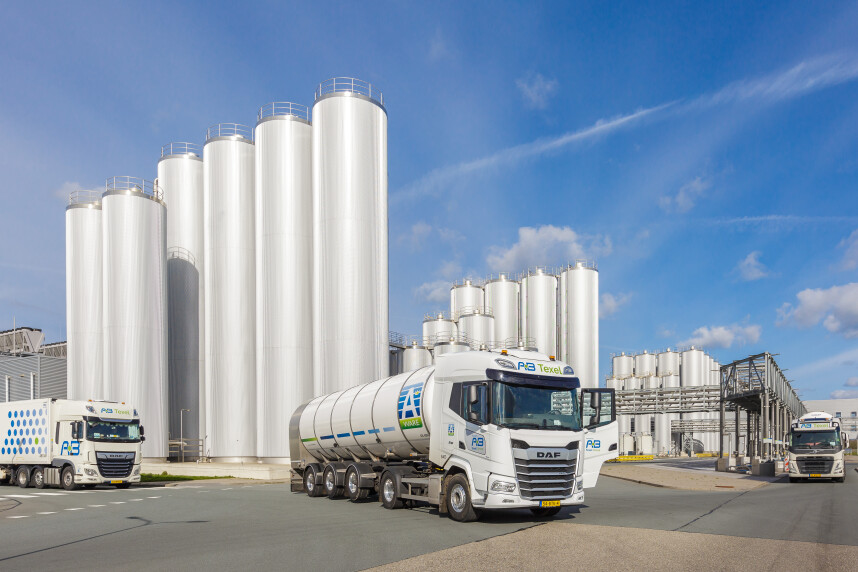
"My father already had his own trucks. So it has old roots. We took over AB Texel in 2011. It is one of the pillars of the Royal A-ware Food Group and now has a fleet of 1.800 trucks and 2.650 trailers. As a result We also have our own RMOs and our own intra-transport. That is not all that AB Texel does, but it makes it possible for A-ware to have as much control as possible when it comes to logistics for our dairy activities."
You continue to grow as a company, in years with high and lower dairy prices. The year 2022 was a great financial year for you. Will 2023 be that again?
"This year has often been challenging, with significantly increasing costs. I would not yet say that it has been a good financial year. So far it has been an exciting year in which we were able to further strengthen and develop our strategy and organization through hard work. ."
In addition to the government's sustainability requirements, are there other matters that you are concerned about?
"There are always matters that require attention. For example, the availability of the right packaging material at the right time remains a concern."