News Milk
Three to four dairies will close in the coming years
Three to four dairies in the Netherlands will have to close by 2030 due to market overcapacity, ABN Amro expects. "The company that loses the battle for milk supply will feel the pain and will eventually have to scale back production," according to a new report from the bank.
The bank expects the number of dairy cows to have declined by 2030% by 8 compared to today. "Dairy processors have large factories with capital-intensive production lines and will be faced with a shrinking milk supply in the coming years," says the reportThe number of dairy factories in the Netherlands fluctuated between 2020 and 2025 between 52 and 54, according to the bank. Due to a shrinking livestock population, overcapacity is looming. According to the bank, some dairy factories will then operate at less than two-thirds of their capacity and will therefore no longer be profitable.
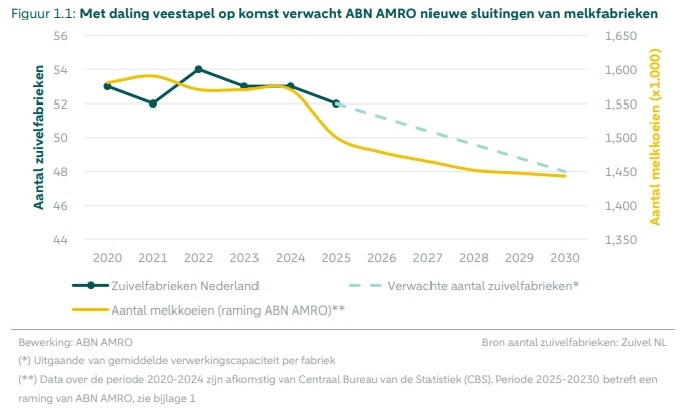
Dairy processors want to retain their suppliers, which is putting upward pressure on milk prices, the bank notes. They also try to "lure farmers with attractive premiums, for example, for their sustainable efforts in grazing or enhancing biodiversity around fields." Dairy farmers are also less loyal to their processors if they can get a better price elsewhere. "The company that loses the battle for milk supply will feel the pain and will eventually have to scale down production," writes the bank, which also notes that dairy processors are looking with interest "at milk produced in the Belgian or German border region" and (international) mergers.
According to the bank, it's difficult to say which factories will close and whether they are new or older. A new, modern factory, the bank argues, can be more efficient and flexible in processing milk into other profitable products, requires less maintenance, and has lower labor and energy costs. On the other hand, depreciation and financing costs are also higher, which increases the cost per product as production volume declines. An older factory has lower depreciation but offers less flexibility and efficiency, according to the bank. "The level of utilization at which it remains profitable to keep the factory running depends on the production location and market conditions."
In its own portfolio, the bank sees that mainly larger conventional dairy farms participate in buyout schemes. Based on this, ABN Amro expects that organic dairy farms (546 in 2024) will make very little use of the Lbv(+) scheme, resulting in a slight increase in the share of organic milk in the milk pool.

Linda van Eekeres
© DCA Market Intelligence. This market information is subject to copyright. It is not permitted to reproduce, distribute, disseminate or make the content available to third parties for compensation, in any form, without the express written permission of DCA Market Intelligence.