Opinions Hans de Jong
Finances, new cabinet will have to make changes
Dutch public finances are in less good shape than the 0,6 deficit of 2023% GDP suggests, the CPB rightly states this week in the Central Economic Plan (CEP). It should be borne in mind that a series of windfalls and incidental factors have had a favorable influence on government finances in 2023.
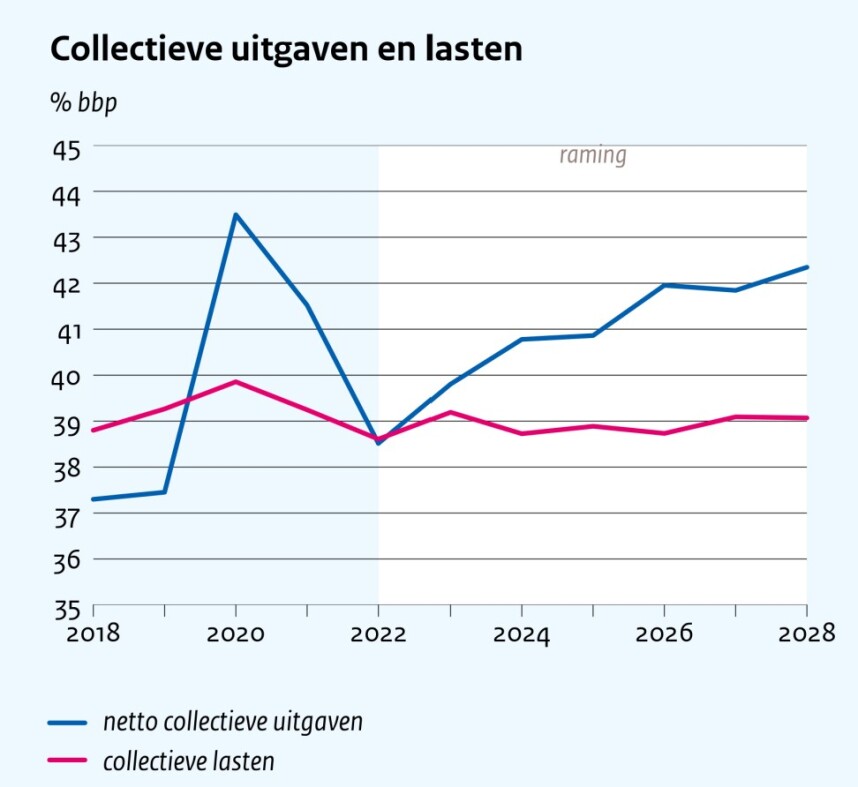
However, the next picture shows that expenditure will increase considerably in the coming years if policy remains unchanged. Because income is stabilizing, there is a gap that is larger than the 3% EMU standard, which you would want to remain considerably below in normal circumstances.
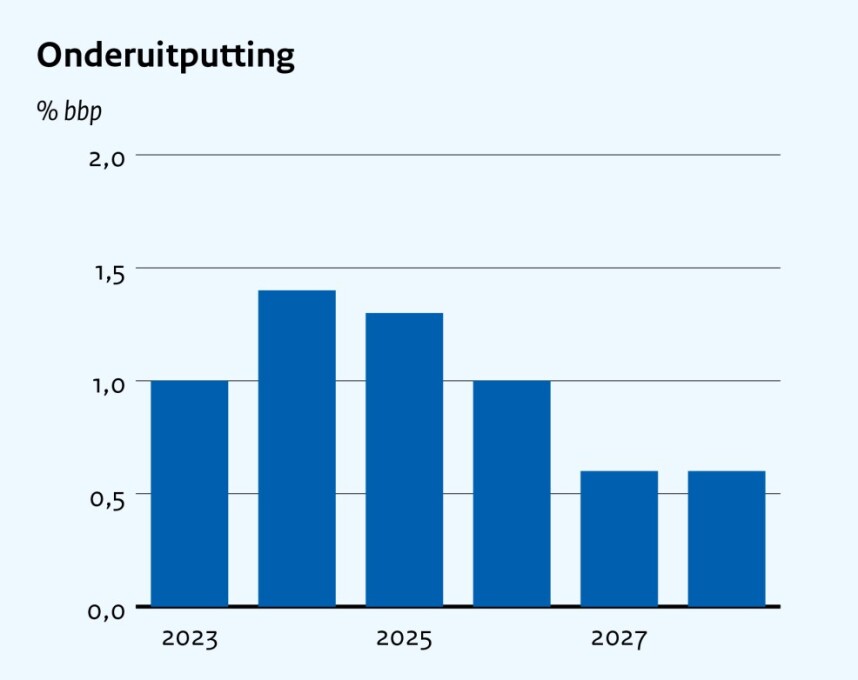
When assessing the budget situation, you must also realize that there is currently significant 'under-exhaustion' of the planned government expenditure. The government is not fully spending its budgets for various reasons. This under-exhaustion will amount to almost 2024% of GDP in 1,5. Nevertheless, according to the CPB, the deficit will amount to 2,1% in the current year. This means that the deficit would be well above 3% if all planned expenditure were realised.
The Budget Space Study Group recommends cuts of €17 billion, while parties that are now eager to govern for the first time have more ambitions regarding expenditure than income and cuts.
According to the CPB, our economy will grow by 1,1% this year and 1,6% next year. That is clearly more than DNB predicted in December (0,3% and 1,0% respectively) and also more than the European Commission recently predicted (0,4% and 1,6% respectively). The CPB says it is more optimistic because they were able to include the good figures for the fourth quarter of 2023. These were not yet known when DNB and the European Commission made their estimates. I doubt whether that statement is correct because for 2023 as a whole, DNB had the same forecast as the realization (+0,1%, indicating that their assumption for the fourth quarter must have been close to the realized figure) and the European Commission overestimated with 0,2% the growth in 2023 is even slightly.
The CPB expects a large contribution from private consumption, driven by a significant improvement in purchasing power. It seems to me that they will be right and that the previous estimates from DNB and the European Commission will turn out to be incorrect. In my opinion, one blemish that emerges from the CEP concerns investments. They already shrank last year and will continue to decline sharply in volume this year. Our country's earning capacity depends largely on investments, so that decline is not nice. Unfortunately, the CEP provides scant details in this area. For the time being, the CPB has not gone further than suggesting that investments always lag behind and that a recovery will occur in 2025. Hopefully the CPB will provide more insight into the investments when they come up with their in-depth document.
House price increases will accelerate
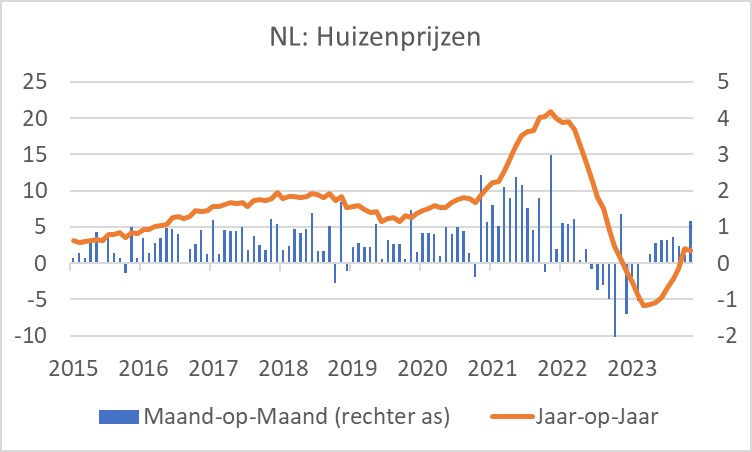
House prices in our country increased by 1,2% in January compared to December and by 1,8% compared to January 2023. The scarcity and increased wages and purchasing power are giving a boost to the price increase. Over the period February to April 2023, prices fell by almost 3%. That now seems unlikely, meaning the year-on-year increase will rise sharply over the next three months. I expect figures above 5% around the middle of the year. That will attract the necessary attention from the media.
The global economy appears to be taking a turn for the better, although it is not yet very convincing. The port of Rotterdam reported this week that freight throughput in 2023 was almost 7% lower than in 2022. As I wrote before, international trade in Asia is showing an improvement. In January, Japan's export value was 11,9% higher than a year earlier. That was the strongest increase since November 2022. The value of exported semiconductor machines in particular grew rapidly: +27,5%. Despite the growth problems in China, Japanese exports to that country were more than 29% higher than in January 2023. Moreover, the value of Japanese imports in January was 9,6 lower than in January 2023. This was mainly due to lower energy prices.
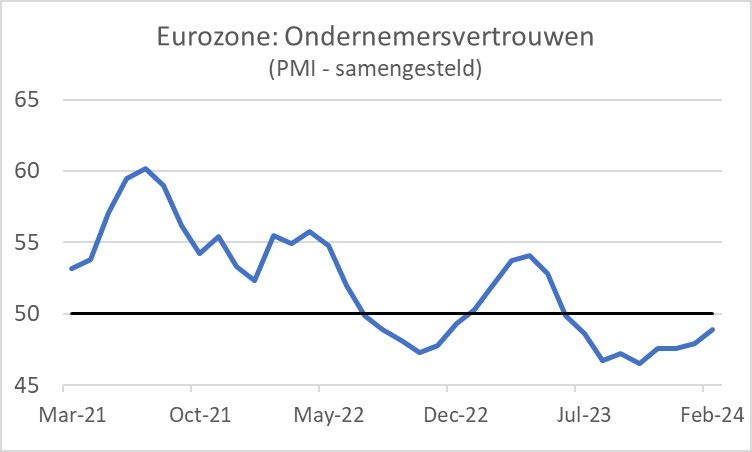
The preliminary figures on the purchasing managers' indices in various countries confirm the picture of an unconvincing improvement in the economy. In the eurozone, for example, the combined purchasing managers' index for industry and services improved in February, but at 48,9 the index still remained below the 'boom-bust' line of 50.
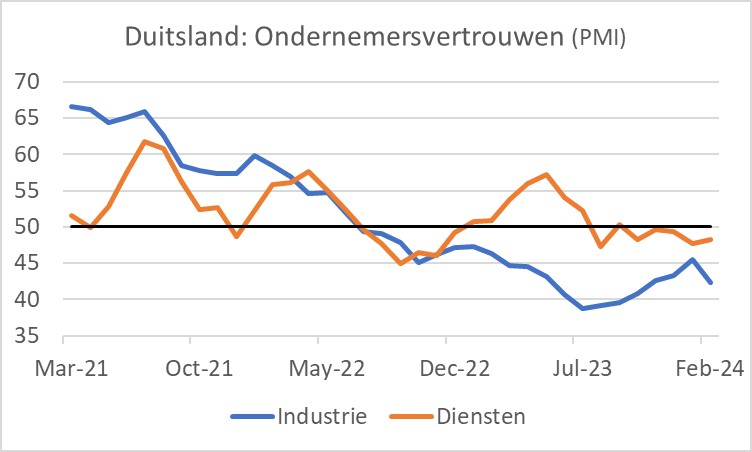
German industry remains a weak link. After several months of increasing confidence, the German purchasing managers' index for industry fell to 45,5 from 42,3 in January. In the German service sector, entrepreneurs may have become slightly less pessimistic, but they are not very cheerful either.
In the US, the confidence of industrial entrepreneurs improved, but that of their colleagues in the service sector declined. However, the American labor market remains tight. Claims for unemployment benefits were just 201.000 in the most recent week. This does not indicate a weakening of the labor market. This may be necessary to moderate wage growth sufficiently to bring inflation to 2% in the medium term.
Closing
We can be brief. Dutch economic growth is clearly doing better this year than last year. This is mainly due to a significant increase in purchasing power. Thus, growth this year is driven by demand. Unfortunately, it says nothing about our longer-term growth potential.
Already existing challenges are not diminishing. Public finances are less favorable than recent figures suggest and, despite the increase in purchasing power, things will not be much easier for first-time buyers on the housing market this year because the rise in house prices will probably accelerate.
The international economy is improving slightly, but it is not strong and the known weaknesses remain.

Hans de Jong
© DCA Market Intelligence. This market information is subject to copyright. It is not permitted to reproduce, distribute, disseminate or make the content available to third parties for compensation, in any form, without the express written permission of DCA Market Intelligence.
- 1.Ample supply puts pressure on cattle prices
- 2.Interest rates on capital markets are rising
- 3.Off-land period weak spot in market
- 4.Euro significantly weaker against dollar
- 5.Rising onion market shows cracks
- 6.The sow population in the EU is not yet shrinking.
- 7.French fries exports impress
- 8.Onion exports picking up pace