Opinions Hans de Jong
There's trouble in the industry
According to the NEVI purchasing managers index, Dutch industrial entrepreneurs became more pessimistic in August. The index fell from 49,2 in July to 47,7, the second decline in a row. That was the lowest level this year.
Incidentally, CBS reported earlier that producer confidence in the industry had become somewhat less negative in August. The NEVI survey is much more extensive than the CBS survey. That is why I attach more value to it.
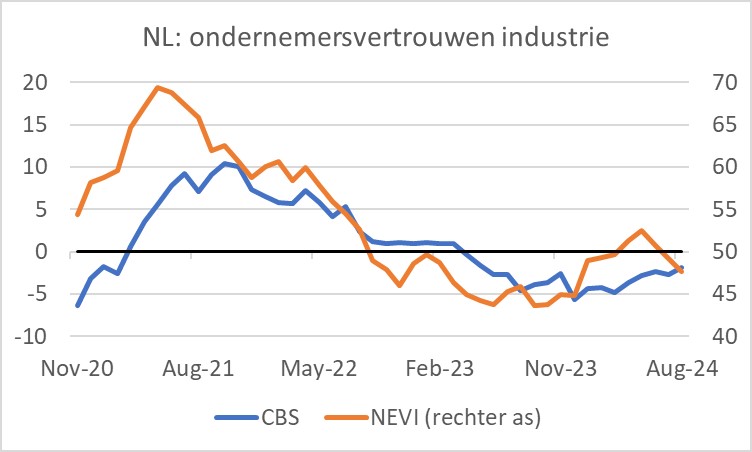
The explanation of the NEVI leaves little to be desired in terms of clarity. New orders, production volume and employment decreased and the main cause is the reluctance of customers. Furthermore, the NEVI reports that companies are faced with higher costs due to higher prices of materials and higher wages. They try to pass this on to customers by passing on the higher costs.
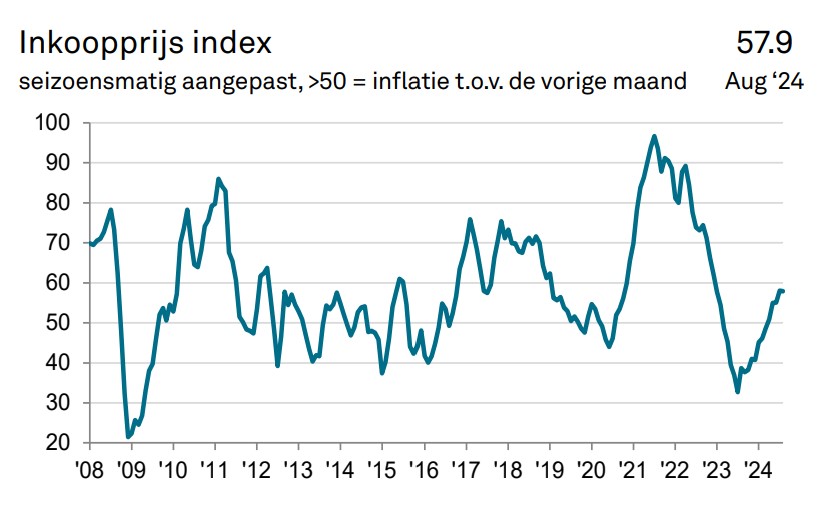
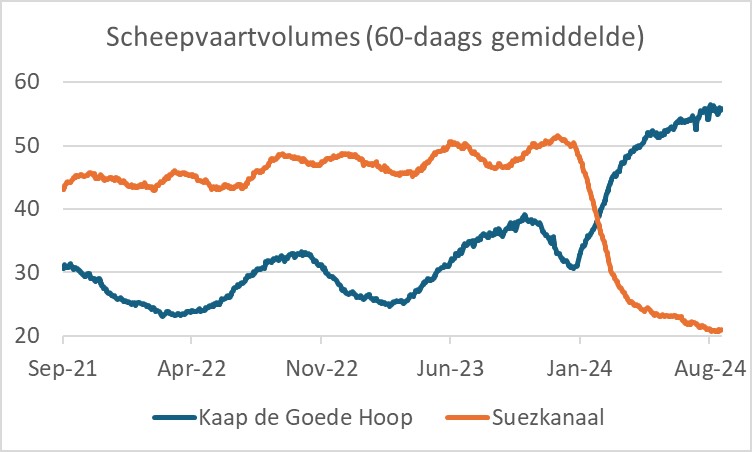
The industry is also currently dealing with disruptions in supply. Due to the unrest in the Red Sea, there is a massive 'detour'. This extends delivery times. It is unclear to what extent this temporarily limits production.
Perhaps the situation in German industry is a bigger problem. However, yesterday Destatis, the German CBS, reported that the volume of orders received by German industrial companies in July increased by 2,9% compared to the previous month, after a very impressive increase of 4,6% in June. That looks positive, of course. Destatis qualified that report somewhat by indicating that the increase was mainly due to orders for aircraft, ships and trains, which increased by more than 85%. These certainly count, but such orders are extremely volatile. Excluding this volatile component, orders fell by 0,4% month-on-month.
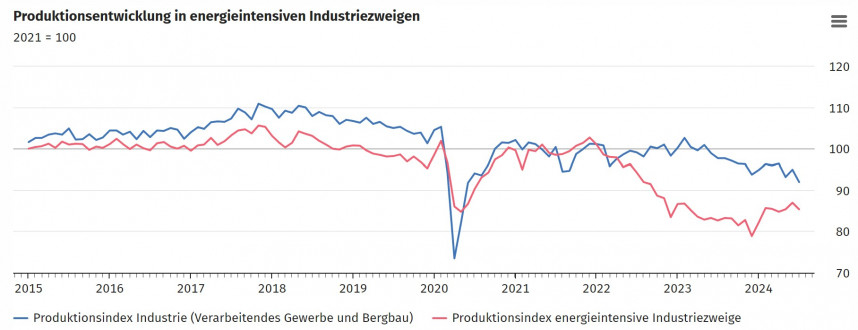
This morning, German statisticians reported that industrial production in July actually fell by 2,4% compared to June. Year-on-year, this is now a disappointing -5,3%. The following graph also shows that the recovery of production in the five most energy-intensive sectors did not continue in July. This may be due to the European gas price, which has risen from €23/MWh since the end of February to €37/MWh now. We will see. Production in these energy-intensive sectors fell by 1,8% month-on-month, but still exceeded production a year earlier by 3,3%. The decline of German industry is particularly evident in the comparison of the current production volume with the peak in 2017. Total production is now 17,0% lower. For the five most energy-intensive sectors, this is even -19,1%.
US economy continues to weaken
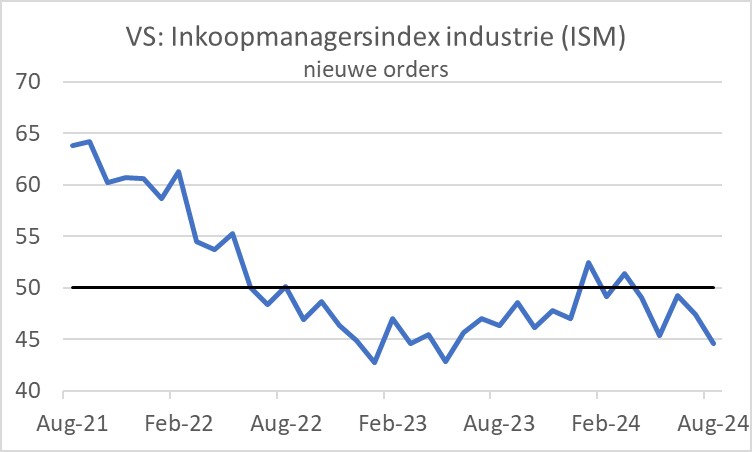
In the US, too, the industry is not doing very well. The development of the production volume is less negative than in our country, but purchasing managers are not positive. According to figures from the leading Institute for Supply Management, American purchasing managers have also become more pessimistic about their order intake in August. Economists like to look at the development of orders because this series offers a glimpse into production.
The Fed published its usual Beige Book this week, which is a key input for the policy meeting in a week and a half. Nine of the 12 Fed districts reported that activity was stagnant or contracting. In May, such reports came from only two districts, while 10 districts reported that local activity was growing. That is quite a change.
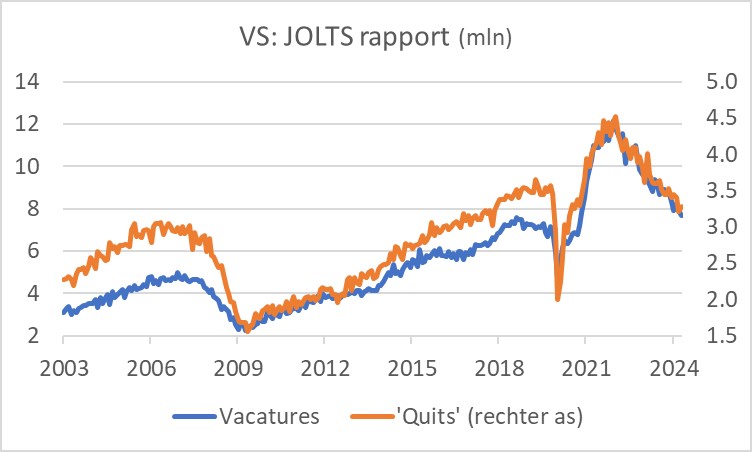
The tension in the US labor market is easing rapidly. In March 2022, a record 12,2 million vacancies were reported. In July of this year, that number was 7,7 million. Still a lot, of course, but the decline is rapid and the level is now comparable to that before the pandemic. The number of people who leave their employer of their own accord (quits) is falling rapidly. This is a sign that they are less optimistic about finding a new job quickly, which indicates a relaxation of the labor market.
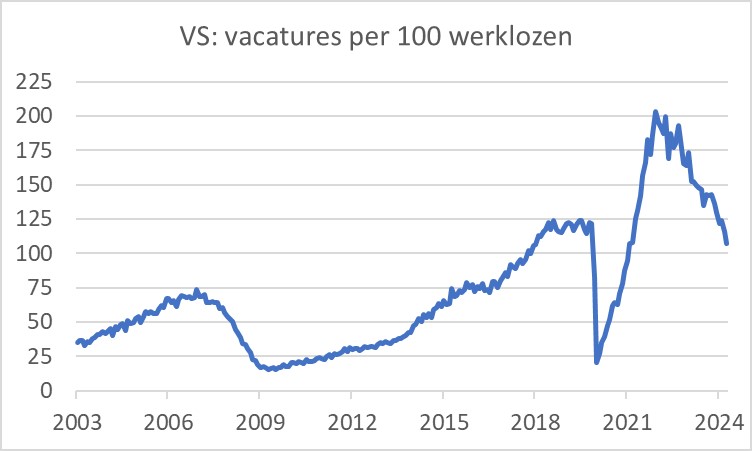
The tension in the labor market is often measured by the ratio between the number of vacancies and the number of unemployed. That figure also shows a rapid cooling of the labor market. In March 2022, there were 203 vacancies per 100 unemployed, now 107. That last figure is slightly below the level just before the pandemic.
Although some other figures paint a more positive picture, I think the US economy is currently cooling rapidly. It is good that the labour market is relaxing, because that reduces the upward pressure on wages, which can reduce inflation. But that relaxation of the labour market may have gone far enough now.
Moderation of inflation in the offing
As for inflation, it is also important that the oil price has now reached its lowest level of the year. Compared to early April, the price is now about 20% lower. As we have seen in recent years, a significant change in the oil price has a delayed effect on the prices of all kinds of other products. Furthermore, the rent increase for new leases has decreased significantly, which is only reflected in the inflation figure with a delay. On balance, I think that a considerable moderation of inflation is in the offing, it is baked in the cake. It cannot be ruled out that inflation will fall below the 2% target in the foreseeable future.
An interesting and somewhat embarrassing combination is emerging for the Fed. A decline in inflation to or even below the target seems imminent to me, and the weakening of the economy threatens to go further than desired. However, the official Fed rates remain high and restrictive. They do not fit in with the current economic outlook at all. There is only one possible conclusion: the Fed is behind the curve, it is lagging behind in its monetary policy.
There is no doubt that the Fed will cut rates on September 18. Whether it will immediately implement a 50 basis point cut remains to be seen. Other central banks have all started with 25 basis points. And that seems most likely for the Fed as well, although some weak macro indicators could strengthen the case for a larger cut. More important, however, is how quickly and to what level the Fed will cut rates in total. My thesis is that the Fed will cut rates significantly within a period of, say, a year. The policy of the new president is an uncertainty in this respect. If that policy is very expansionary, that could prevent rate cuts. However, before there is clarity about such a policy, we will already have had several rate cuts further.
Closing
According to the CBS, Dutch industry may have made a significant contribution to the remarkably strong GDP growth in the second quarter, but the mood among purchasing managers has soured considerably in the third quarter so far. That does not offer a pleasant perspective for GDP growth in the third quarter, but those figures are still a few months away.
In German industry, things will continue to be a mess for the time being. The figures on incoming orders are helped by so-called bulky items (planes, ships and trains), but production continues to decline. When will the end be in sight and what are the plans in Germany to halt the decline of its own industry?
In the US, I think there is an undeniable weakening of the economy. I also think that inflation will fall to or below the Fed's target in the foreseeable future. In my view, the Fed is quite behind the curve and significant interest rate cuts are therefore in the offing.

Hans de Jong
© DCA Market Intelligence. This market information is subject to copyright. It is not permitted to reproduce, distribute, disseminate or make the content available to third parties for compensation, in any form, without the express written permission of DCA Market Intelligence.
- 1.Liquid dairy market takes a step back
- 2.Regrowth cannot save the potato harvest.
- 3.A slimmed-down Farmel performs better.
- 4.Super record in onion exports
- 5.Higher potato price for the grower as well
- 6.GDT auction beats expectations
- 7.FrieslandCampina on protein trend
- 8.Lactalis Leerdammer raises milk price