Opinions Hans de Jong
Bizarre spectacle at Fed construction site
The ECB left interest rates unchanged. This was expected. Due to tensions surrounding international trade, uncertainties are high, much greater than usual. But even without these uncertainties, the interest rate would likely have remained unchanged. We are in a good place, said ECB President Lagarde.
Inflation is exactly at target, medium-term inflation expectations are also in line with the target, and economic growth, while not exuberant, is quite reasonable. The economy currently needs neither stimulus nor restraint through interest rates. And since the ECB's deposit rate is 2,0%, which the ECB considers "neutral," it made sense to leave interest rates alone.
Lagarde remained incredibly noncommittal during the press conference. Board member Isabel Schnabel recently said that further rate cuts are unlikely in the near future ("the bar is high for further rate cuts"When Lagarde was asked for her opinion on that statement, she said that there are different views within the board and that this diversity of opinions is a blessing.
The minutes of the previous meeting noted that some board members were concerned that inflation might remain too low for too long. This, in fact, argues for further interest rate cuts. Asked for comment on this, Lagarde shrugged and said something like, "Oh well, there are always board members who think that."
Vice President Luis de Guidos had said at the ECB conference in Sintra that a strengthening of the euro above $1,20 would be undesirable. Since the beginning of the year, the euro has already risen from $1,03 to $1,18, reaching its highest level since 2021. Such a rise depresses inflation through lower import prices, but also activity through loss of competitiveness. De Guidos's comment raises the question of what the ECB will do if the currency does indeed rise further above $1,20. Lagarde was, of course, asked for a response. But she effectively brushed that question aside. She said, correctly, that the ECB does not have an exchange rate target, but that the exchange rate does, of course, influence inflation forecasts. In my view, Lagarde chose the sensible course here. It is highly doubtful whether the ECB can prevent further exchange rate appreciation. If you brazenly claim to prevent further appreciation, you lose your credibility if it turns out you are unable to do so. This does not alter the fact that the ECB may try to slow down further appreciation with some statements.
When asked about her view on the consequences of the trade war, Lagarde essentially said she doesn't really know either. That was honest and realistic. We still have to wait and see what is ultimately agreed between the EU and the US, but also between the US and other countries. It's difficult to predict how all this will affect economic growth and inflation. While I initially thought some interest rate cuts were in the works this year, I now think the ECB will keep its interest rates at their current levels for longer. It will take some time before it becomes clear how the economy will develop after (hopefully) reaching a trade agreement with the US. And because we're in a good place, there's no rush.
Trump inspects Fed building renovation – bizarre!
Donald Trump visited the Fed yesterday to inspect the renovation of one of its buildings. The renovation was budgeted at $1,9 billion before the pandemic, but the Fed is now targeting a cost of $2,5 billion. This is easily explained. Material and labor costs have risen sharply during and after the pandemic. The project has also faced unforeseen construction setbacks. There is much more asbestos than anticipated; the building dates back to the XNUMXs.
It was a bizarre spectacle. As a real estate mogul and "bully," Trump was completely in his element on the construction site. Fed Chairman Powell, on the other hand, unsurprisingly, seemed extremely uncomfortable. In front of the cameras, Trump claimed the cost would be $3,1 billion. Powell shook his head, was handed a piece of paper by Trump (see image), and concluded that the president had mistakenly added the construction costs of another building to the calculation. Incidentally, there has also been criticism of how the renovation is being carried out: far too much lavish luxury.
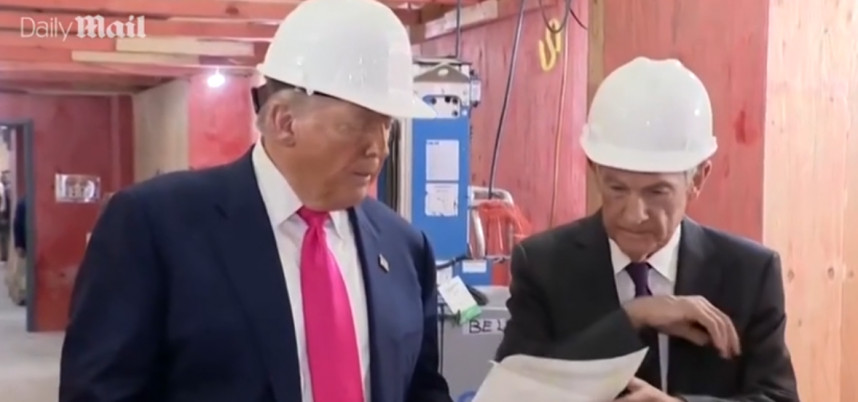
In reality, this was just a "peeing contest," or rather, Trump was "peeing" at a demonstration. He wanted to show Powell who was boss, and he wanted to intimidate him. It was painful to watch.
The Fed is meeting next week to discuss interest rates, and I can't imagine a rate cut will be decided. A rate cut would give the impression that Trump is being pandered to, which undermines the Fed's independence. There's also a strong argument to be made for leaving interest rates unchanged. The previous meeting was on June 17th and 18th, when it was unanimously decided to leave interest rates unchanged. The economic indicators released since then, in my view, provide no reason to make a different decision now. But we'll see. The interest rate level can still be characterized as moderately restrictive, and if you believe such a restrictive rate is no longer necessary, you can certainly decide to cut rates. Nevertheless, I'm betting on "no change." I do think the Fed will lower rates after the summer. What would help is if Trump kept his mouth shut for a while.
EU-US trade deal near
At the time of writing, a trade agreement between the EU and the US appears imminent. The details are not yet known, and negotiations could potentially continue until August 1st. Longer is also possible if the tariffs threatened by both sides in the event of no agreement by August 1st are postponed. We'll see. Reportedly, we'll face import tariffs of 15%. That's not easy for me. We don't know exactly which goods will be exempt, so we don't know how high the "average tariff" will be. But it will certainly be considerably higher than it was before. In 2024, the average effective import tariff was approximately 2,5%. For cars, steel, and aluminum, 15% is a deterioration compared to 2024, but an improvement compared to what was already implemented in 2025 (27,5% on cars, for example). According to media reports, aircraft and aircraft parts will be mutually exempt. That sounds good, but is it? The EU has a bilateral deficit with the US in the trade of these goods. We import more from the US than we export to it.
I don't see anything about pharmaceuticals yet. Trump has recently made strong protectionist statements regarding pharmaceuticals in general. It's a key sector in mutual trade. The EU exports approximately €90 billion worth of goods to the US annually. Incidentally, we import €50 billion worth of goods from the US annually. I asked ChatGPT what they think: They believe pharmaceutical products will be exempt from tariffs. I'll have to wait and see. To be continued.
Incidentally, the US has reached an agreement with Japan. A 15% import duty will also apply between these countries. Car exports are particularly important for Japan. Before Trump's re-election, a 2,5% duty was in effect. As of April 2nd, 25% was added to that duty, as all cars entering the US are now subject to this duty. Now, the duty on Japanese cars has increased from 27,5% to 15%. Share prices of Japanese car companies soared. But now American car manufacturers are complaining. They still rely on imported parts, which for now remain subject to the 27,5% duty. These American companies are now arguing that the government is actually giving Japanese car companies a competitive advantage in the American market. This demonstrates the complexity of these kinds of agreements and their potential for unintended consequences. Revisions, adjustments, and so on remain conceivable.
Consumer confidence improves
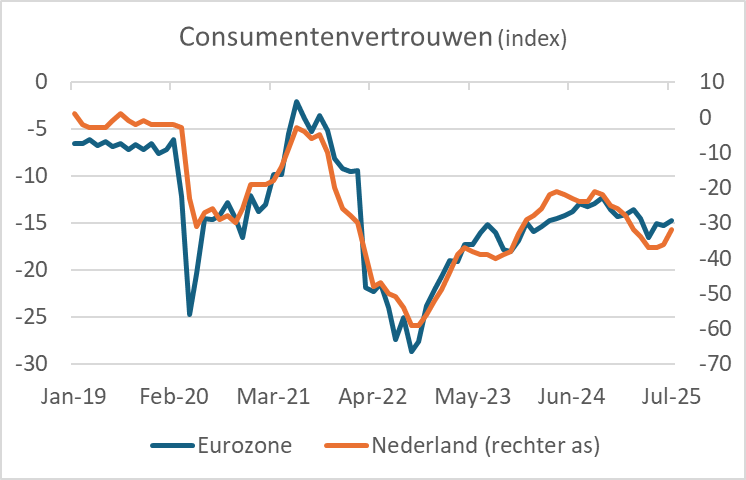
The CBS consumer confidence index for the Netherlands rose to -32 in July, significantly less negative than the -36 in June. However, that -32 is still well below the long-term average (around -10). All five sub-questions posed by CBS in this survey received less negative responses. I consider this a positive development. The improvement was in line with the rise in consumer confidence in the eurozone as a whole, from -15,3 in June to -14,7 in July. The values of these figures are not readily comparable, but the following chart provides a clear picture.
German entrepreneurs slightly more positive again
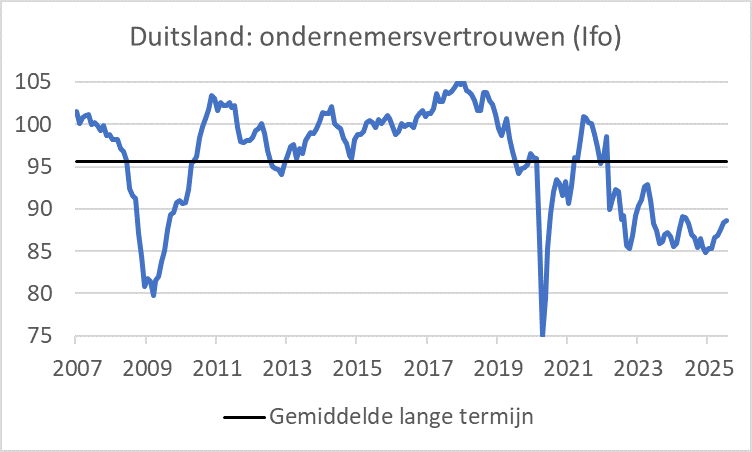
The Ifo index, which measures German business confidence, rose for the seventh consecutive month in July: 88,6, compared to 88,4 in June and 84,8 in December of last year. Both sub-indices improved slightly. The expectations component rose from 90,6 in June to 90,7, and the assessment of the current situation rose from 86,2 to 86,5.
Industry and construction entrepreneurs were slightly more positive in July than in June, but in the service and trade sectors, they actually became less optimistic. The Ifo's chief economist's commentary is less than enthusiastic. He calls the German economic recovery "broke," or bloodless. The chart makes his point clear. Fortunately, there has been improvement for seven consecutive months, but in historical perspective, it's still not easy.
Nevertheless, quite a bit has changed in Germany since the beginning of the year. The new government has released the debt brake and has decided on significant investments in infrastructure and defense. Moreover, earlier this week, the government met with top business leaders, where the business community committed to a €631 billion investment package. That sounds promising, but only €100 billion of that is for new projects. We'll see what comes of it. Investments in infrastructure are certainly not unnecessary, but Germany is facing a whole range of challenges. I'm thinking of the following:
- Neglect of infrastructure. Something is finally being done about that.
- Excessively high energy prices are hampering key energy-intensive sectors. I don't see a clear strategy that will lead to success here.
- Germany is traditionally strong and innovative in "old sectors" and has little strength in new technology sectors. I don't see a clear strategy here either. It seems they're continuing to focus on sectors from the "old economy." The summit earlier this week was mainly attended by representatives from the old economy. I wonder how successful that can be. Why did companies like ASML and several others emerge from Philips in our country, while Siemens hasn't, or has done much less, in Germany? Perhaps the defense industry offers a major opportunity. It's the type of industry in which Germany is strong (engineering), and it may offer opportunities to combine high-tech with an old industry.
- Problems in the automotive sector, partly due to their own fault, partly due to Chinese competition. I wonder if German car companies can survive the Chinese competition.
- High labor costs. That remains a problem
Of course, I hope for the best, especially since our own economy remains partly dependent on Germany. But I genuinely wonder whether the new government's initiatives adequately address the actual problems.
World trade shows no signs of slowing down
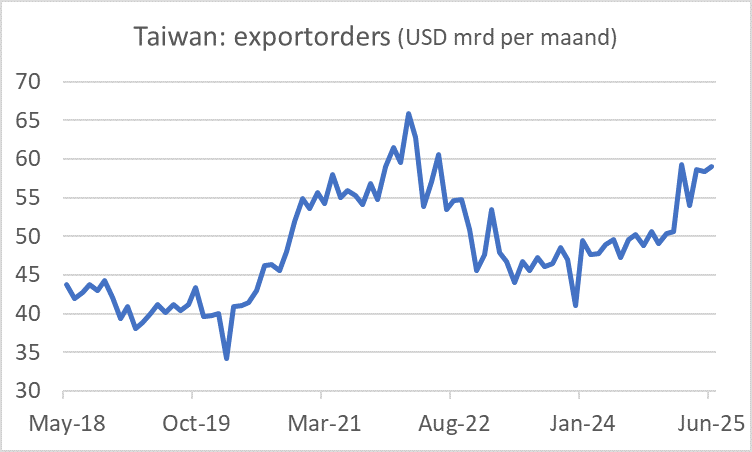
As ECB President Lagarde said yesterday, much remains unclear about the consequences of the uncertainties surrounding Trump's import tariffs. There's no other option than to carefully review all relevant data. Since the beginning of this year, Taiwanese export orders have been rising significantly. This is understandable, as everyone wanted to preempt Trump's tariffs. On April 2, he announced a 32% tariff on Taiwanese goods, but these "reciprocal" tariffs have been postponed for three months. So, they're still hanging over the market, and time is running out. Meanwhile, it's notable that Taiwanese export orders remain high. The value of Taiwanese export orders was 24,6% higher in June than a year earlier. ASEAN countries are leading the way: +41,7%. Then come Japan (+38,5%) and the US (+34,8%). The continued positive trend in these orders may be related to the fact that the much higher tariffs are still hanging over the market. However, I suspect it has mainly to do with the strong global investment cycle in IT.
Closing
The ECB is leaving interest rates unchanged, and Lagarde is essentially saying that in Frankfurt, too, they don't know exactly where the economy will go. In any case:we are in a good place' and I suspect that interest rates will remain unchanged for quite some time now.
Trump inspected the renovation of a Fed building. Officially, because the costs far exceeded the original budget. But he was probably just showing who's in charge. Still, I suspect the Fed will leave interest rates unchanged next week.
Apparently, a trade agreement is imminent between the US and the EU. Because too many details are missing, it's difficult to make a final assessment, but a 15% base rate doesn't sit well with me. Let's hope that many goods are exempted so that the average tariff will be much lower.
Dutch consumers are becoming less pessimistic, just like their European counterparts. According to the Ifo index, German businesses became slightly more positive again in July, the seventh consecutive month of growth. Moreover, German companies have agreed with the government to invest heavily in the German economy. Fingers crossed…
Taiwanese export orders remain strong for the time being. This offers hope for the global economy.

Hans de Jong
© DCA Market Intelligence. This market information is subject to copyright. It is not permitted to reproduce, distribute, disseminate or make the content available to third parties for compensation, in any form, without the express written permission of DCA Market Intelligence.
- 1.New shortage of onion seeds looms
- 2.Innovator fails to recover from heatwave
- 3.Phosphate rights drive up the cost price
- 4.Vreugdenhil milk price catches up
- 5.Quality and supply determine the onion price
- 6.The harvest proceeds in fits and starts.
- 7.US farmer debt burden is record high
- 8.Weak third-quarter tractor sales