Opinions Hans de Jong
Beef prices are rising faster in our country than in our neighbours
Every week there's something to report about what US President Donald Trump has been up to. This week is no exception. However, I'm starting this week off quietly and close to home. Don't worry, we're also writing a few new chapters this week in the book "Peculiarities of Trump." But let's start with inflation in the Netherlands.
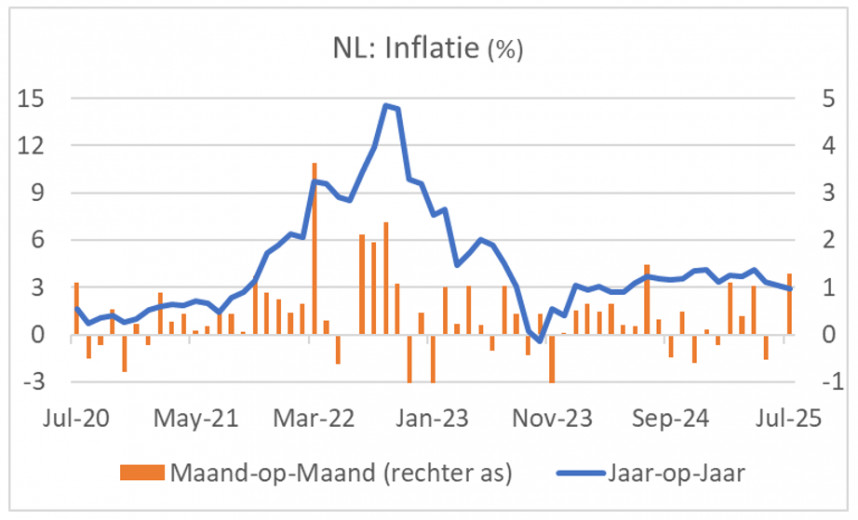
As Statistics Netherlands (CBS) already reported in its "rapid estimate," Dutch inflation fell from 3,1% in June to 2,9% in July. The inflation rate could fall slightly further in August, but after that, it will become more difficult because the net price level fell in the final months of last year. A further decline is not impossible, however. The IEA predicts significantly lower oil prices next year due to an expected supply surplus, and Trump's trade war could lead to cheaper imports into the EU.
Employers' organization AWVN reports that wage pressure is gradually easing. The collective labor agreements signed in July included an average wage increase of 3,7%, slightly lower than the 3,6% in June. The average for this year so far is 4,0%. In 2024, it was 4,9%. In the detailed price statistics, we are therefore seeing inflation in labor-intensive services decreasing somewhat.
Crucial role for rents
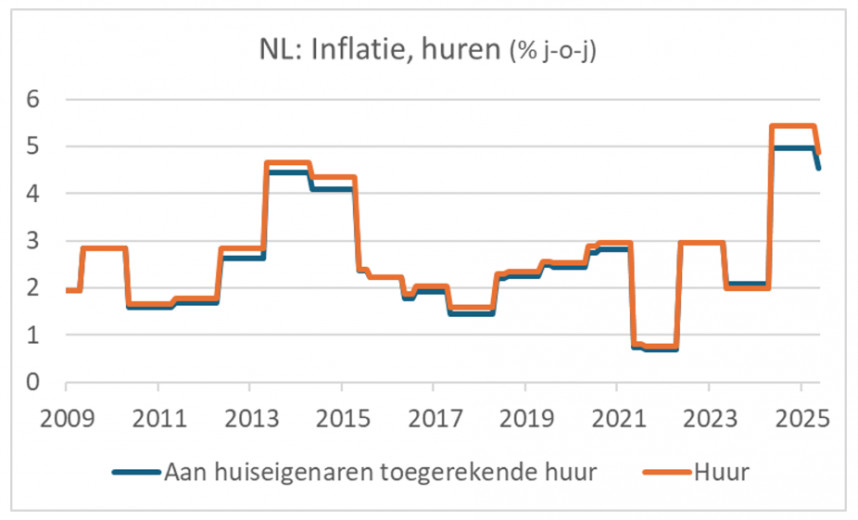
When Statistics Netherlands (CBS) publishes the "final" inflation figures, a wealth of detail becomes available. I was very curious about the increase in rents. They make up about 20% of the basket and, in CBS statistics, rise more or less exclusively in July. Last year, the rent increase (a combination of actual rents and rent increases attributed to owners) was 5,4%. This was significantly higher than in 2023, pushing the total inflation figure up by about 0,7%.
Initially, a similar rent increase was threatened this year. However, the now-caretaker government decided to freeze rents for social housing, but that decision was reversed. Ultimately, the rent increase was 4,9%, reducing the overall inflation rate in July by approximately 0,1 percentage point.
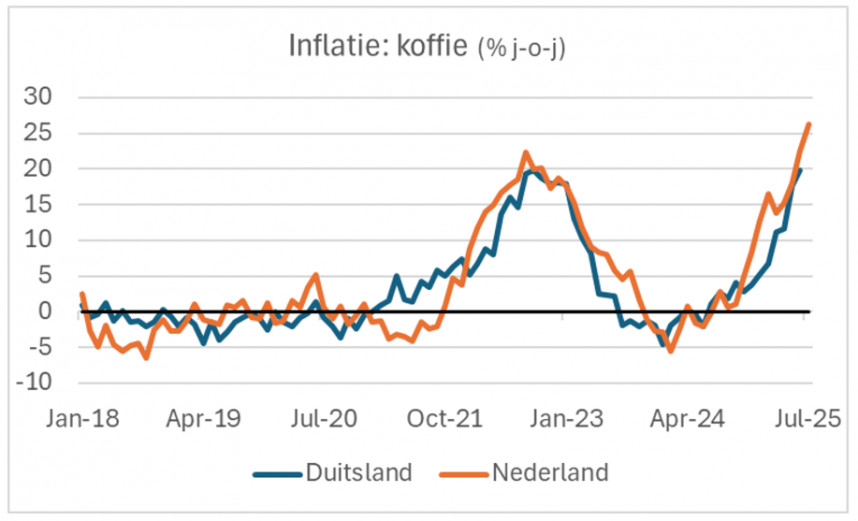
Food prices are often influenced by international developments. For example, coffee prices on the global market have been rising for some time, and so coffee is becoming more expensive in our country. In July, coffee prices in our country were a full 26,3% higher than a year earlier. The following graph shows that coffee is also becoming more expensive in our German neighbors, and at a similar pace, although the source I consulted doesn't yet have July figures for Germany.
Dutch beef price increase unusual
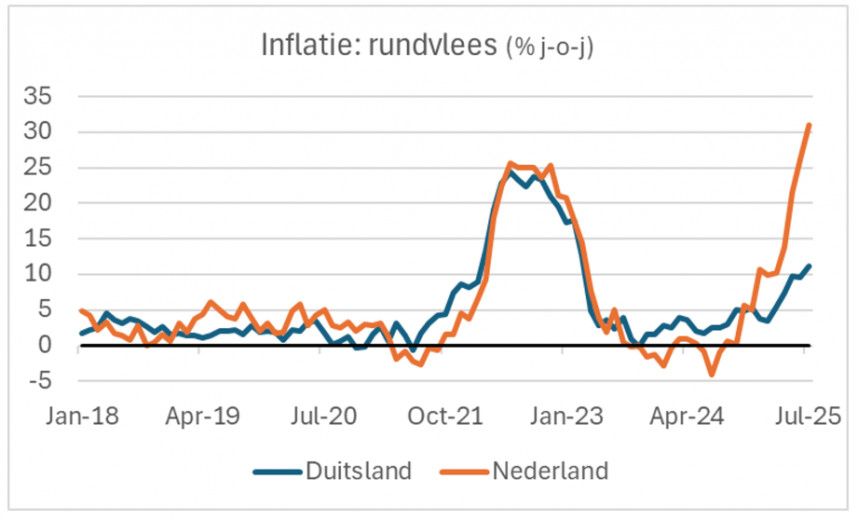
The situation is different for beef. There too, the global market price has risen, but unlike coffee, the price of beef is rising faster in the Netherlands than in Germany. These figures don't reflect the absolute price level, but in the Netherlands, beef was a full 31,0% more expensive in July than a year earlier.
In Germany, it's "only" about 12% more expensive, while the price trends in both countries have been relatively similar in previous years. In Belgium and France, beef prices are also rising much less rapidly than here. I don't know why. I've read that a reduction in livestock numbers plays a significant role here, but whether that explains the difference compared to Germany, Belgium, and France, I don't know.
Moderate European economic figures
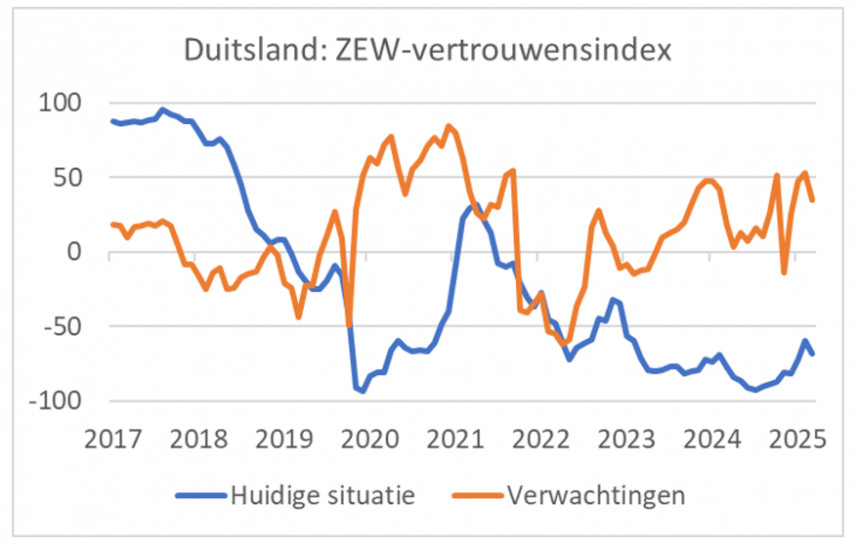
The ZEW index, which measures the confidence of economists and analysts, fell in August after three months of growth. This applies to both the eurozone and German indexes. Industrial production figures (for June) in the eurozone were also not encouraging. Perhaps we shouldn't attach too much importance to a few monthly figures, but it's to be hoped that the decline in the ZEW index is temporary and doesn't signal a cyclical slowdown. However, I'm worried, as I don't really see where the growth momentum is supposed to come from.
In the US, there's been much discussion about the disappointing development of the number of jobs. The head of the statistical agency responsible for the figures was even fired by President Trump over it. The American economy has certainly weakened over the course of this year. Nevertheless, business confidence in small and medium-sized enterprises (SMEs) improved in July, and the number of people applying for unemployment benefits is certainly not showing an alarming upward trend. The numbers still point to a slightly weakening, but robust, labor market.
Trump's wrath for dissatisfied economists
Discussions about the impact of Trump's tariffs on US inflation continue. So far, the effects have been less severe, and the effects appear to be more limited than economists had predicted. This last point hasn't escaped Trump's attention, and he has said that investment bank Goldman Sachs should fire its Chief Economist because his predictions (higher inflation) don't seem to be coming true.
This has caused quite a bit of unrest among my acquaintances among bank economists (I'm in a WhatsApp group with about 30 (former) bank economists from around the world), including several American economists. Bank economists from emerging markets are offering support to the Americans. The former often have to deal with politicians who comment on unfavorable analyses by bank economists. Sometimes people feel personally threatened.
Consequences for import duties
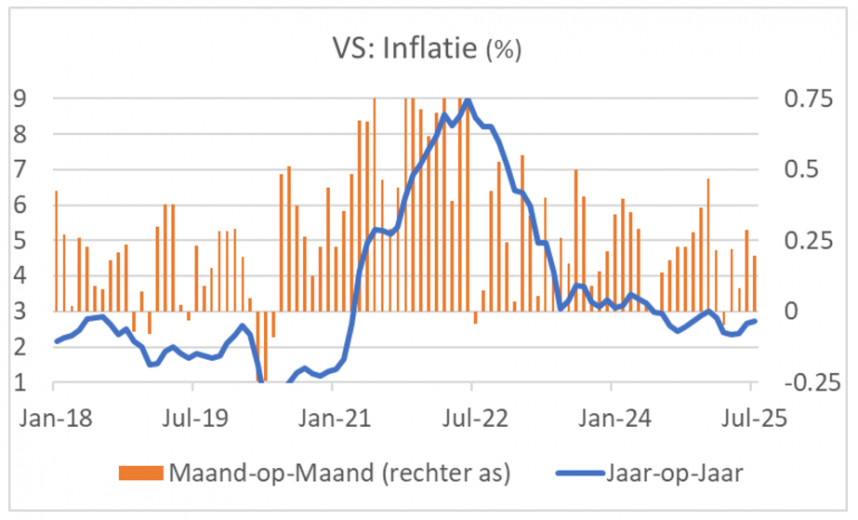
Regardless, US inflation was 0,2% month-on-month (mom) and 2,7% year-on-year (yoy) in July. YoY inflation also stood at 2,7% in June. Core inflation did rise, reaching 0,3% mom in July and accelerating yoy from 2,9% in June to 3,1% in July. Bank economists are trying to determine whether the details of the statistics provide insight into the impact of the import tariffs. As mentioned, this appears to be rather limited. Goldman Sachs economists believe that consumers have borne about 20% of the tariffs so far. Foreign suppliers have thus far barely borne any of the burden, so that the majority falls on domestic businesses.
But that would be a temporary situation because domestic businesses, partly due to the uncertainty, have largely not yet raised consumer prices and have not yet sufficiently pressured foreign suppliers to lower them. Goldman Sachs economists expect that American consumers will ultimately bear around 60% of that burden. If that's true, we will still see somewhat higher inflation rates in the coming months. Nevertheless, I expect interest rate cuts, because you could argue that these slightly higher inflation rates represent a kind of one-time shock.
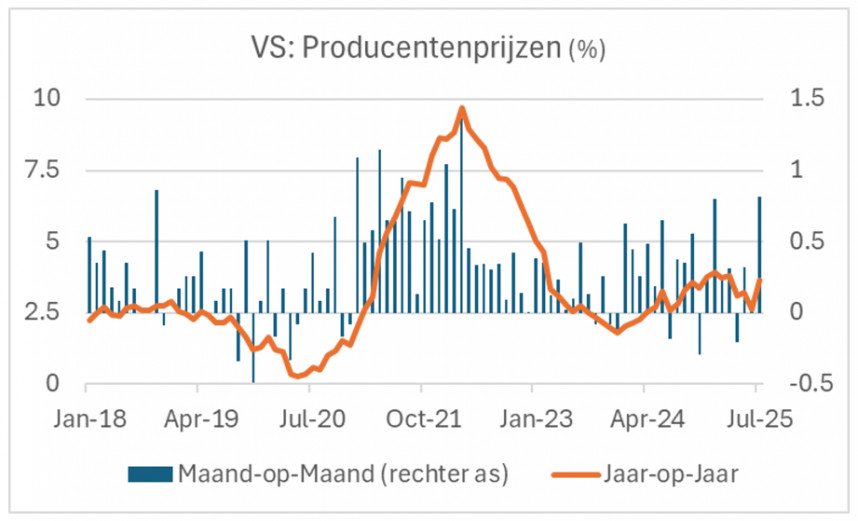
US producer prices rose 0,9% mom in July. This was a significant setback (the strongest monthly increase in three years) and perhaps confirms that domestic businesses are currently absorbing the majority of the burden of import tariffs. The yoy figure rose from 2,4% in June to 3,3% in July. Excluding food and energy, producer prices rose from 2,6% in June to 3,7% in July. It should be noted, however, that producer prices are much more volatile than consumer prices, which also experience much higher and lower fluctuations.
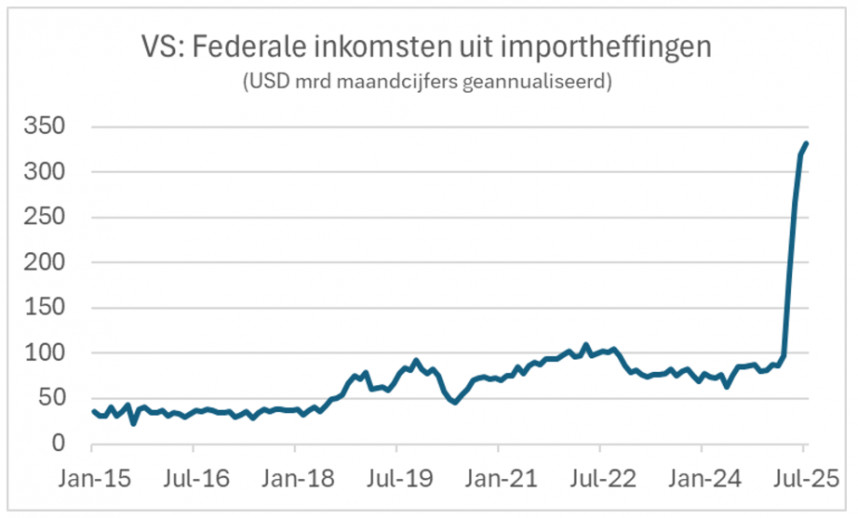
Trump's import tariffs are starting to have a clear impact on federal revenues under the heading "import duties." This is understandable, as the average import tariff is many times higher than it was, and import volumes haven't declined to the same extent. Before Trump raised the tariffs, revenue from import duties amounted to approximately US$80 billion annually. It has now reached approximately US$330 billion. This increase represents approximately 5% of federal government revenues and about 0,8% of GDP. So, these are clearly more than negligible amounts. These figures say nothing about the long-term costs of this policy in terms of reduced dynamism, as companies are less exposed to foreign competition.
Chinese exports to EU increasing
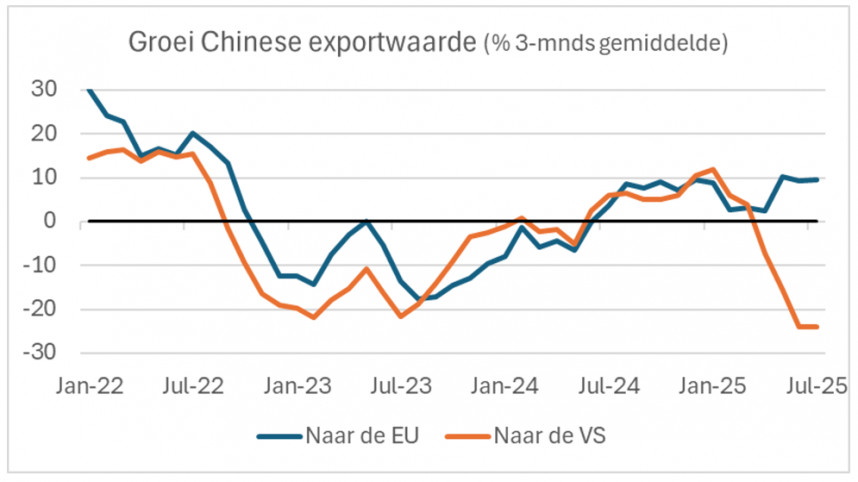
Trump's import tariffs are also having a clear impact on Chinese exports to the US. In value terms, they are currently falling by around 25 to 30% compared to last year. We are feeling the effects of this in the EU. Although Chinese exports to the EU are showing no more than a steady growth of around 10% in value terms, we should keep in mind that prices are likely to fall. This is because the Chinese are trying to sell what they no longer sell in the US elsewhere in the world. Therefore, in terms of volume, Chinese exports to Europe will grow more strongly.
Because President Xi Xi has instructed Chinese companies not to compete too aggressively on price in the domestic market, they are competing even more fiercely on price in foreign markets. This is being felt in various sectors within the EU. The knock-on prices of Chinese suppliers are tempting for buyers, but European suppliers are left behind. The European Commission is closely monitoring all this and will impose import duties if necessary. These already amount to 45% on Chinese cars.
Deal tastes like more
The Trump administration has introduced another novelty. It had imposed restrictions on Nvidia's export of high-end chips to China. This cost Nvidia dearly in terms of its operating profit and stock price. But now the administration has reached a deal with the company. It will receive a license to export certain chips to China in exchange for 15% of the proceeds. In an interview, Treasury Secretary Scott Bessent said that such a deal is entirely new and has left him wanting more.
The government has apparently reached a similar agreement with AMD, and talks are reportedly underway with Intel, which reportedly involves a government stake in the company. Such agreements may be new to governments, but the mafia has been doing business this way for a long time. It shouldn't get any crazier. But it's highly likely that it will get even crazier.
Closing
Inflation in our country was finally set at 2,9% in July. The lower rent increase than last year depressed the figure by approximately 0,1 percentage point. As in other countries, coffee prices are rising sharply here, while beef prices are rising much faster here than in neighboring countries. The latest economic indicators for Europe paint a rather bleak picture. Hopefully, this is temporary, but I'm worried.
Trump's import tariffs have so far had only a limited impact on inflation. Economists expect these effects to intensify in the coming months, but they also expect them to be one-time effects. Therefore, higher inflation figures should not prevent interest rate cuts.
This week, we're adding a few more chapters to the book "Peculiarities of Trump." First, he's urging the resignation of Goldman Sachs' Chief Economist. Something like that never happened to me when I was chief economist at ABN AMRO. In fact, I once received applause from then-Prime Minister Mark Rutte. Second, government revenues from import duties are rising dramatically. And third, Trump is now making some very strange deals with individual companies, making them pay for export licenses (although we also have to pay for construction permits, for example...). The latest in this "saga" is even that the US government seems to be acquiring a stake in Intel. It reminds me of the mafia and communism (or, if you prefer, state capitalism). To be continued, no doubt (and perhaps Trump, eventually, too...).

Hans de Jong
© DCA Market Intelligence. This market information is subject to copyright. It is not permitted to reproduce, distribute, disseminate or make the content available to third parties for compensation, in any form, without the express written permission of DCA Market Intelligence.
- 1.Smooth onion exports positive for sentiment
- 2.Grazing enters a new phase
- 3.Milk supply in the negative for the first time
- 4.New shortage of onion seeds looms
- 5.Innovator fails to recover from heatwave
- 6.Phosphate rights drive up the cost price
- 7.Vreugdenhil milk price catches up
- 8.Quality and supply determine the onion price