Opinions Hans de Jong
Trump raises tensions over interest rate policy
US President Donald Trump is demanding the resignation of Lisa Cook, governor of the US Federal Reserve. This is another chapter in his personal life. Meanwhile, the Fed is becoming heavily politicized, which is highly undesirable. Are there finally good arguments for or against lowering the official interest rate in the United States?
Lisa Cook was appointed by Joe Biden, Trump's Democratic predecessor, in 2022. The position she held was originally scheduled to expire in early 2024. Therefore, Biden reappointed her in 2023 for a full 14-year term. Cook was the first female Fed director of African descent. This week, she came under fire after the Federal Housing Financing Agency accused her of mortgage fraud.
It is suspected that Cook, before joining the Fed, purchased two homes and declared the property as her primary residence in both mortgage applications. For the financial institution providing the loan, the risks are lower when the client lives in the property themselves. With rentals, there is a risk of tenant default and vacancy, making it harder for the owner to meet repayment obligations. Therefore, if you get a mortgage for a home you live in yourself, the lender charges a slightly lower interest rate. But you can only have one primary residence. Failing to provide truthful information on a loan application constitutes fraud. Apparently, 22.000 such fraud cases are detected annually in the US. Cook denies the allegations and does not wish to resign.
I'm no lawyer, but I find this a strange story. First of all, it seems like the authorities are heavily investigating all Fed officials. That's not very nice. More importantly, however, this seems to me to be a fairly clear-cut case. You either provided false information when applying for the loans or you didn't. It would be foolish to accuse someone of fraud without solid evidence. On the other hand, it would also be foolish to deny it if you're guilty. Apparently, there's a gray area. It's possible that Cook used both properties and didn't rent either one out, although various media outlets are reporting that one of them was at least offered for rent. Be that as it may, this will likely be clarified soon. How hard can it be? If Cook is guilty, her position at the Fed is untenable. Trump will then have a chance to nominate a "kindred spirit" to the board.
Jackson Hole
As I write this on Friday, August 22nd, the Jackson Hole conference has begun, but Fed Chairman Jerome Powell hasn't yet spoken. Meanwhile, the Fed is becoming heavily politicized. That's highly undesirable. I've recently been accused of being far too positive about Trump. I don't think that's true. But I do maintain that not everything Trump does is wrong. And not everything he says is nonsense or a lie. The appropriate question here is: are there actually any good arguments for or against lowering the official interest rate in the US? Let's look at the various arguments and leave emotion aside.
The starting point is that the Fed's interest rate should be considered "moderately restrictive." That is, the interest rate depresses activity, which is necessary to ensure that inflation approaches the Fed's target. The goal of maximum employment is not currently under threat.
It should also be noted that while both the Fed and the European Central Bank (ECB) lowered interest rates last year, it now assumes the ECB will continue to do so this year, while the Fed will not. While this difference is far from unprecedented, the difference between the two central banks' interest rates is considerable.
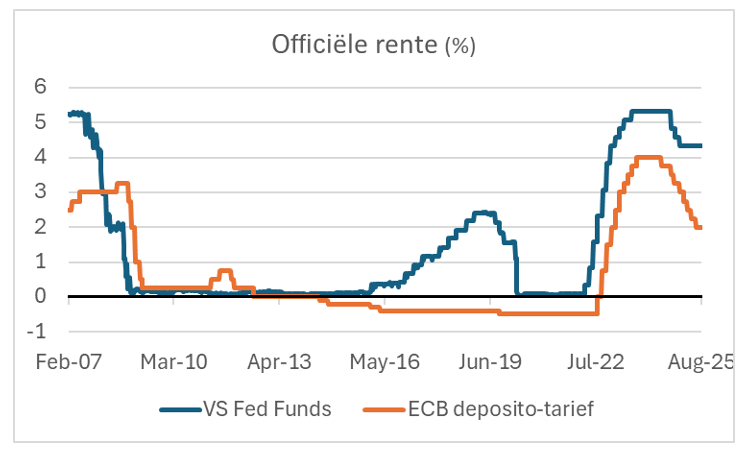
US inflation is above target and may rise slightly in the coming period due to Trump's import tariffs. This argues in favor of leaving interest rates unchanged. However, one could argue that the inflationary impulse from the tariffs is a one-time shock, and the Fed needs to "look through it."
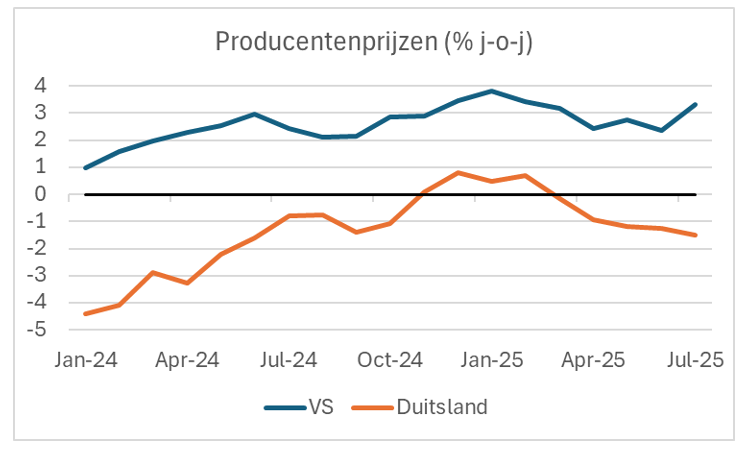
The latest producer price figures may illustrate the difference in short-term inflation between the US and Europe. The rise in US producer prices has accelerated recently, while in Germany it hasn't. (To avoid confusion: producer prices are more volatile than consumer prices. This explains why producer prices in Germany fell for a while in 2024.)
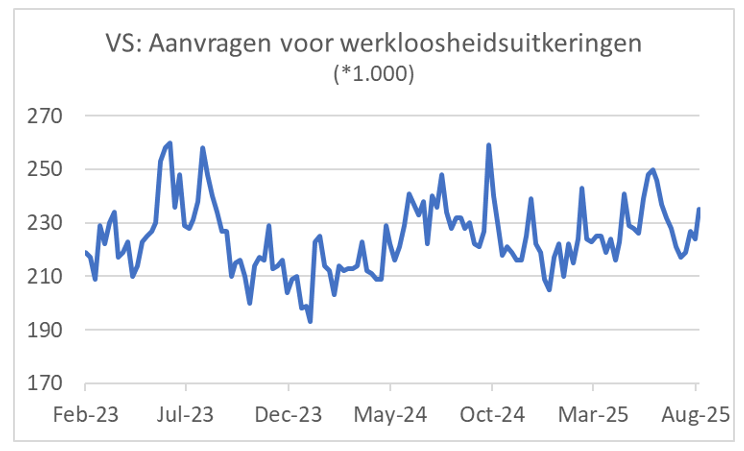
Furthermore, the economy has undeniably weakened, and, as discussed earlier, the notable revisions to job growth figures suggest that the labor market has also weakened significantly. On the other hand, other data describing the labor market's condition are inconsistent with the picture of a significant weakening. While the number of unemployment benefit applications has risen somewhat in recent weeks, it has not been alarming.
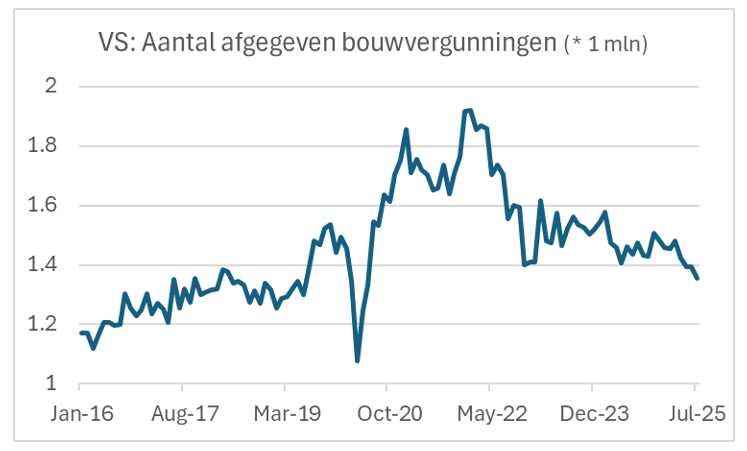
An interest-rate-sensitive sector like housing is certainly under pressure. The following chart shows that the number of building permits issued for residential properties has recently declined and has now reached a very low level. This argues for interest rate cuts. Remember, Trump is a real estate entrepreneur and understands the impact of interest rates on activity in his own sector.
What would I do?
I'm inclined to think I would lower interest rates in this situation. I think the inflation risks are limited, and the risks of an undesirable slowdown in economic growth are actually somewhat greater. In such a situation, a "moderately restrictive" official interest rate is inappropriate. I suspect that the majority of the Fed will share this view later this year, and that rate cuts are indeed on the way.
Fed boss wannabes are profiling themselves
Those who want to succeed Powell as Fed chair are raising their profile and seem to be almost bidding against each other with their advocates for interest rate cuts. James Bullard, president of the St. Louis Fed for 15 years, has apparently spoken with Treasury Secretary Bessent about the job. He says he supports rate cuts of 100 basis points this year, starting in September. In an interview on Fox News, he also presented himself as a much more balanced candidate for the job than some other names mentioned. To be continued.

Hans de Jong
© DCA Market Intelligence. This market information is subject to copyright. It is not permitted to reproduce, distribute, disseminate or make the content available to third parties for compensation, in any form, without the express written permission of DCA Market Intelligence.
- 1.Milk price back above the spot market
- 2.Extremely high prices for phosphate rights
- 3.Avebe raises potato price after all
- 4.Vion reports another heavy loss
- 5.Red diesel allowed again in the US
- 6.Arable Farming Market Quarter: October
- 7.Higher milk price at Hochwald
- 8.Euro significantly weaker against dollar