Opinions Hans de Jong
Entrepreneurs more positive in economically turbulent times
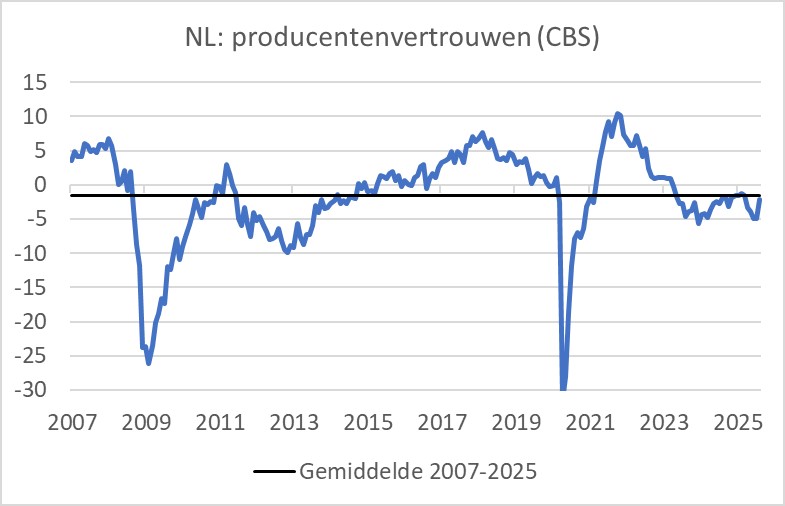
According to the CBS survey, Dutch business confidence in manufacturing improved in August. The index rose from -4,9 in July to -2,2, bringing it close to its average since 2007. All three sub-indicators improved.
For the sub-indicator "expected activity," the number of positive responses exceeded the number of negative responses. This is quite striking, as you might think the concerns surrounding US import tariffs would actually dampen sentiment. Apparently, there is some cyclical improvement after all.
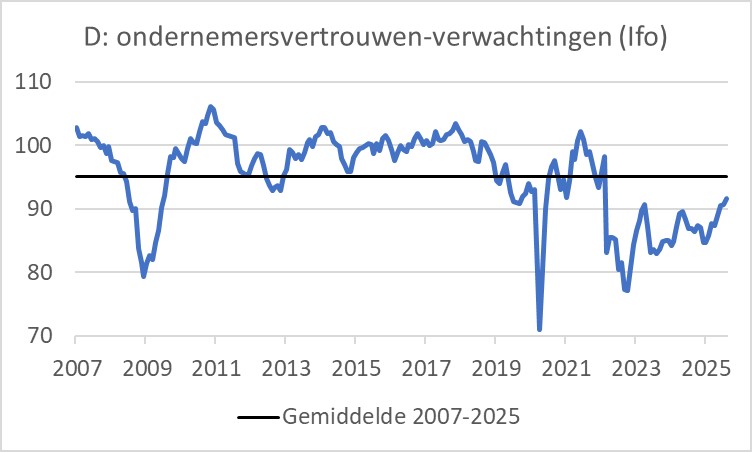
German businesses also became more optimistic in August. The Ifo index rose slightly: from 88,6 in July to 89,0. This was mainly due to the expectations component. Although the indicators are not entirely comparable (the Ifo index also includes companies in the service sector), the difference with the CBS index is nevertheless interesting in the sense that German producer confidence is still somewhat further removed from the longer-term average. This may indicate that the challenges facing German businesses are greater than those facing Dutch businesses.
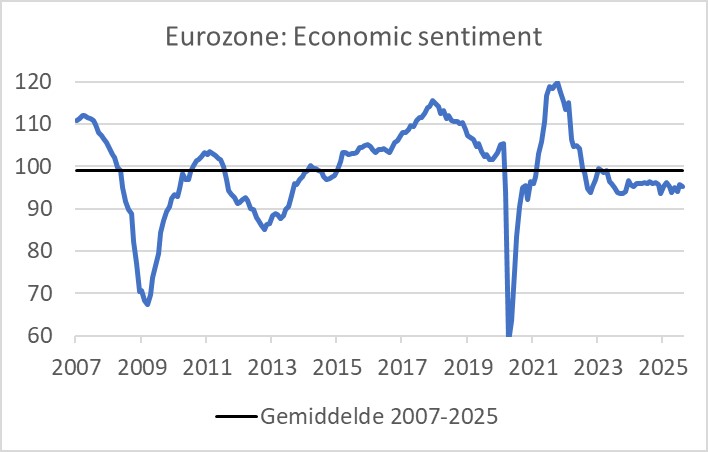
The eurozone's economic sentiment index actually fell slightly in August: from 95,7 in July to 95,2. This index is even broader than the CBS index and the Ifo index. Economic sentiment measures not only producer confidence but also consumer confidence.
The debate about the US economy continues. Earlier this month, the sharp downward revision of the figures for the number of jobs created in May and June led to a flurry of controversy and the resignation of the head of the Bureau of Labor Statistics. Trump believes the figures are being manipulated to create the impression that the economy is not performing well under his leadership.
During his speech at the Jackson Hole conference, Fed Chairman Powell addressed this. He noted that while job growth had weakened significantly, the labor market nevertheless remains very tight. This was confirmed again this week by the unemployment benefit claims figures. They remain consistently low and show no increase. One would expect an increase in unemployment benefits if the labor market deteriorated significantly. In the most recent week, the number of jobless claims was 229.000, compared to 234.000 the week before, and there has been no clear upward trend in recent months. Powell rightly pointed out, in my view, that this apparent inconsistency may be related to the development of the labor force. Due to the halt in immigration and the deportation of undocumented immigrants, it is shrinking. I think Trump is completely missing the point here. The August job growth figures are due to be published next week. I'm curious to see what those will look like, although it's possible that the statistical agency, under new, Trumpian leadership, won't publish any figures at all and will first conduct a thorough internal audit to eliminate any appearance of fraud.
The US economy grew by 3,3% (annualized) in the second quarter compared to the first. Growth was previously estimated at 3,1%. This strong growth figure follows the slight contraction in the first quarter. The figures do not provide a clear insight into the state of the economy. They are significantly distorted by the import tariffs. In the first quarter, companies tried to anticipate the tariffs. As a result, imports of goods increased by a substantial 51,6% in that quarter. This depressed GDP growth by almost 5 percentage points. In the second quarter, when the higher tariffs were announced and partially implemented, imports of goods actually fell by 34,6%. This boosted GDP growth in the second quarter by 4,9%.
More indicative of the developments is that consumption growth amounted to 1,6% (annualized) compared to the first quarter. This is neither impressive nor worrisome. Business investment in fixed assets recorded a healthy 5,7% (annualized) increase in the second quarter compared to the previous quarter. While companies invested less in buildings, they increased their investments in equipment and, especially, intellectual property: 7,5% and 12,8%, respectively.
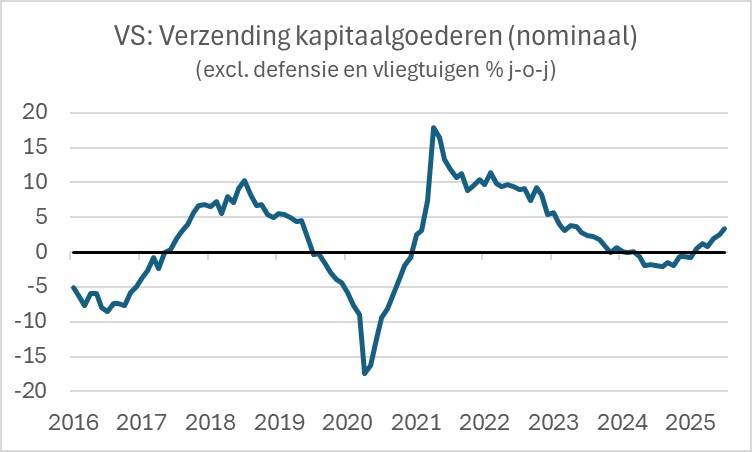
The monthly series of durable goods orders showed positive figures in July. In that report, I'm primarily looking at the figures for "shipments of capital goods excluding defense and aircraft." This is an indication of investments in machinery. Shipments in July were 3,4% higher than a year earlier. The chart shows an upward trend in recent months.
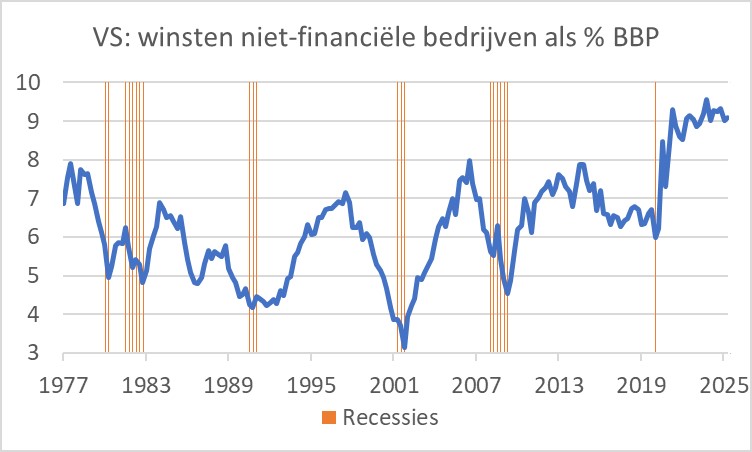
The revision of the second-quarter GDP figures also included figures on corporate profits, which have risen. Corporate profits are a key indicator of economic activity. Recessions are invariably preceded by declining corporate profits. This is not currently the case. Therefore, my assessment is that a recession in the US is not imminent.
Closing
Dutch industrial entrepreneurs became slightly more positive in August. They expect their business activity to increase in the coming months. The CBS index is close to its long-term average.
German entrepreneurs have also become somewhat more positive, although their sentiment index still lags somewhat behind the long-term average.
The US economy grew strongly in the second quarter, but those figures are distorted by import tariffs. Nevertheless, the figures for private consumption and business investment paint an encouraging picture.

Hans de Jong
© DCA Market Intelligence. This market information is subject to copyright. It is not permitted to reproduce, distribute, disseminate or make the content available to third parties for compensation, in any form, without the express written permission of DCA Market Intelligence.
- 1.Van Dellen and Verstraten on nitrogen
- 2.New indices for the pig farming industry
- 3.Wheat hitches a ride with corn
- 4.Vreugdenhil milk price back in the pack
- 5.Onion exports are doing good business.
- 6.Peace talks influence grain trade
- 7.Can the milk price take another step?
- 8.Compound feed significantly more expensive again
- 1.The Netherlands loses 182.000 hectares of agricultural land.
- 2.Belgapom takes a big step with listing increase
- 3.Rabobank: higher wheat price and expensive diesel in 2027
- 4.Beet sugar content rising, half acreage still to be harvested
- 5.Manure trade waits and sees, farmer postpones as long as possible