Inside: Pigs & Feed
DCA Beursprijs 2.0 takes rest after yo-yo weeks
It can be in the pig market. Last week, quotes still threatened to fall, but this week the market is stabilizing again, while the underlying mood is described as price-supporting. With the current pricing, slaughterhouses are in any case not penalized and that immediately releases demand for pigs. An analysis of the pig market.
Read this article?
Become a subscriber and get instant access
Choose the subscription that suits you


After the pig supply was tight in the first two weeks of this year, there was more supply again last week. It was not the case that slaughterhouses were flooded with pigs, but the Dutch slaughterhouses did not have to make any effort to fill the last hooks. On the one hand, this was due to the fact that German slaughterhouses had less ambitious slaughter plans. On the other hand, some pigs were brought forward in week 3 with a view to further reductions. Incidentally, it is usually only a relatively limited number of pig farmers who speculatively shift pigs, but it does determine the weekly mood.
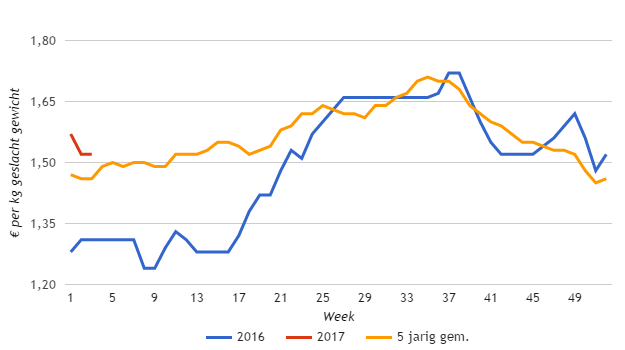
Despite the fear of another German cut in week 3, the Nord/West quotation was trading sideways this week at 1,52 euros, while the 'big boys' in Germany, such as Tönnies and Vion, also went along with this willingly. Due to the significant German reduction in week 2, the pig market had already reached the point where slaughter became interesting again. The need to slaughter at normal capacity utilization rates was further reinforced by the fact that the meat market has definitively left the holiday rhythm behind. The cold temperatures logically create more demand for 'traditional Unox' products and this encourages companies such as Unilever to enter the meat market.
The pig supply for next week is therefore certainly not too large - partly due to the low temperatures in Europe - although the weights are on the high side. As a result, the market even tends to rise cautiously. The increase of 4 cents that the internet exchange (€ 1,60) made on Friday is a typical example of this. Although too much emphasis should not be placed on this, because only 1.700 pigs were traded. This is of course only a fraction of the total trade that takes place in Germany every week.
Anyone who listens to the market will notice that both pig farmers and the slaughterhouse prefer to limit price fluctuations. At least, at least the Dutch slaughterhouses. What the pork market actually needs is a few weeks of rest and stabilization. In this way, the pig supply can flow evenly, while slaughterhouses are not overcharged with the current pricing and are given the opportunity to enforce increases on the meat market, the thinking goes. This works reasonably well on some parts of the pig. Bacon's sales to England, on the other hand, are again under pressure due to the devaluation of the English pound.
The DCA Stock Exchange Price 2.0 therefore takes a break in week 4 and remains at 1,46 euros. In this way, slaughterhouses actually get the opportunity to enter the meat market. Since the pig supply in mid-January is on the tight side under normal slaughter plans, this may be the signal for slaughterhouses to put more pressure on the meat market in any case. The quotation for live pigs remains unchanged at 1,15 euros.