News Pigs
Vion withdrawal shakes up German pig market
The German slaughter figure has risen for the first time in nine years. Vion's retreat is clearly leaving its mark. Remarkably, Tönnies, which is taking over the German branch of the company, is not able to profit from this. The big winner also turns out to be surprising.
Read this article?
Become a subscriber and get instant access
Choose the subscription that suits you


In 2024, the number of pig slaughters in Germany rose slightly for the first time since 2016, with a total of 44,65 million slaughters. This is an increase of around 1,8% compared to 2023. However, this increase only represents a temporary respite within a long-term downward trend. Between 2016 and 2023, the number of slaughters fell by as much as 25,8%, which has left deep scars on the German meat sector.
In 2024, a significant number of slaughterhouses were closed again, and the effects of this are clearly visible on the market. Especially in regions where the processing infrastructure was already vulnerable, such as Brandenburg and Hesse, this development leads to longer transport distances for pigs and a further weakening of the regional meat processing chain.
Shifts
North Rhine-Westphalia retains its traditional number 1 position but continues to shrink. The number of slaughters increased by 2,3% to 16,72 million pigs. Lower Saxony follows with 13,43 million slaughters. Bavaria is in third place at a distance, where 3,79 million pigs were slaughtered. In addition, a significant increase is noticeable in Saxony-Anhalt, where 8,7% more pigs were slaughtered. Meanwhile, the slaughter figure in Brandenburg fell by no less than 13,5% to 1,4 million pigs. The largest percentage increase was observed in the small Saarland, where 100.000 pigs were slaughtered.
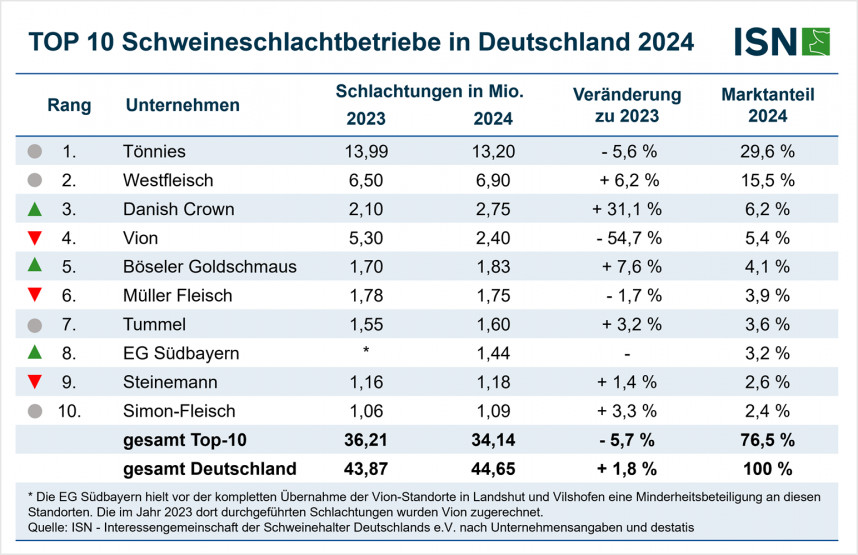
Looking at the slaughterings per company, we see that Vion's decision to leave the German market has caused major shifts. Vion's share fell by no less than 54,7%, to 2,4 million pigs. This decline was particularly beneficial to Danish Crown, which saw its slaughterings increase by 31,1%: from 2,1 million to 2,75 million pigs. Westfleisch (+6,2%) and the smaller Böseler Goldschmaus (+7,6%) also saw their slaughterings increase significantly. Tönnies remains the largest player, but it is remarkable that their slaughtering figure fell by 5,6%: from 13,99 million to 13,2 million pigs.
